

O. Srivani
Center for Soil and Crop Management Studies, Department of Agricultural Meteorology, Tamil Nadu Agricultural University, Coimbatore, India
V. Geethalakshmi
Center for Soil and Crop Management Studies, Department of Agricultural Meteorology, Tamil Nadu Agricultural University, Coimbatore, India
R. Jagannathan
Center for Soil and Crop Management Studies, Department of Agricultural Meteorology, Tamil Nadu Agricultural University, Coimbatore, India
K. Bhuvaneswari
Center for Soil and Crop Management Studies, Department of Agricultural Meteorology, Tamil Nadu Agricultural University, Coimbatore, India
L. Guruswamy
Center for Soil and Crop Management Studies, Department of Agricultural Meteorology, Tamil Nadu Agricultural University, Coimbatore, India
Asian Journal of Agricultural Research
Year: 2007 | Volume: 1 | Issue: 3 | Page No.: 119-124







ABSTRACT
A study was conducted to evaluate the impact of future climate change on the productivity of major cereal crop, rice at different time periods of 21st century (2020, 2050 and 2080). Future changes in temperatures and precipitation for the years 2020, 2050 and 2080 were acquired from HADCM3 model run outputs and integrated with the base year (2000) data for creating weather files to run INFOCROP model in order to predict the yield of the study crops under changing environment. The rice variety chosen for simulation was IR 36 and different CO2 concentration levels viz., 376 ppm, 414 ppm, 522 ppm, 682 ppm were used in the INFOCROP model at different time periods (2000, 2020, 2050 and 2080) for assessing the impacts on crop productivity as projected in the IPCC (2001) report. The crop growth and productivity simulated for the future climate using INFOCROP model indicated that the crop duration, days to anthesis, LAI and DMP of rice crop steadily decreased from 2000 to 2020, 2050 and 2080 due to increase in temperature under enriched CO2 levels. The magnitude of decrease from 2050 to 2080 is expected to be more than that of from 2000 to 2020 and 2020 to 2050. Similarly model recorded the less number of grains per square meter over years. Hence the study reveals prominent negative effects of future climate change on rice crop which shows the necessity to alter the management practices suitable to it.
PDF Abstract XML References Citation
How to cite this article
O. Srivani, V. Geethalakshmi, R. Jagannathan, K. Bhuvaneswari and L. Guruswamy, 2007. Impact of Future Climate Change on Growth and Productivity of Rice Crop in Tamil Nadu. Asian Journal of Agricultural Research, 1: 119-124.
DOI: 10.3923/ajar.2007.119.124
URL: https://scialert.net/abstract/?doi=ajar.2007.119.124
DOI: 10.3923/ajar.2007.119.124
URL: https://scialert.net/abstract/?doi=ajar.2007.119.124
INTRODUCTION
Agricultural activities are very sensitive to climate and weather conditions. The agricultural sector represents 35% of India’s Gross National Product (GNP) and as such plays a crucial role in the country’s development and economy. The rate of increase in crop production even in irrigated areas in India in the last decade of the 20th century has declined (Gadgil and Rao, 2000). This indicates that the crop production in the country has entered the regime of non-sustainability. This situation is due to the degradation of aerial, edaphic and hydro environments arising from the neglect of the effects of climate on several aspects of crop production in farm management. Naylor et al. (2007) reported a marked increase in the probability of a 30-day delay in monsoon onset in 2050, as a result of changes in the mean climate, an increase in precipitation later in the crop year (April-June) of ≈10% but a substantial decrease (up to 75% at the tail) in precipitation later in the dry season (July-September) which indicate a need for adaptation strategies in Indonesian rice agriculture, including increased investments in water storage, drought-tolerant crops, cropdiversification and early warning systems. High frequency at low yield and high variances of rice yield could pose a threat to rice yield at most selected stations in the main rice areas of China (Fengmei et al., 2007).
Crop-Weather Simulation Models (CWSMs) seek to predict the phenology and yields of crops from inputs of weather data and would thus serve an excellent tool to study the effects of climate change on crop production. Some times, their use for agroclimatological and crop planning purposes, vis-a vis the climate change, is also rendered complex. Simpler models can be effective in assessing influence of climate change provided they are designed to seek answers to specific questions and are based on sound and well established eco-physiological principles of crop production with relevant data. Assessment of the effects of global climate changes on agriculture might help to properly anticipate and adapt farming to maximize agricultural production. This situation necessitates finding out the impact of climate change on crop production.
MATERIALS AND METHODS
The study was conducted at regional level in Tamil Nadu to assess the impact of future climate change based on the HADCM3-GCM A2a scenario runs on the productivity of rice using INFOCROP model. The study was conducted for 10 selected districts spread over five agro climatic zones of Tamil Nadu viz., Northeastern zone, Northwestern zone, Western zone, Cauvery Delta zone and Southern zone. The other two agro-climatic zones of Tamil Nadu viz., hilly zone and high rainfall zone were not considered for this investigation as the area under the study crops were meager. In each agro-climatic zone, two representative places were selected for the study.
Creation of Baseline and Future (2020, 2050 and 2080) Weather Data
Past thirty years daily weather data from 1976 to 2005 was averaged and the daily average values were considered as baseline data. With the baseline data, climate change scenario values obtained from HADCM3 A2a scenario outputs have been integrated for creating weather files of 2020, 2050 and 2080. Monthly temperature changes were directly considered for computing the daily changes of that particular month in question as the model output was downloaded as daily temperature deviation for the concerned month during 2020, 2050 and 2080. As rainfall data is discontinuous, from the HadCM3 model output, the expected monthly percentage deviation was worked out and the changes were integrated with the daily rainfall data of the concerned month.
 |
 |
 |
 |
Climate Change Impact on Crops
The impact of climate change on crop productivity was evaluated by running Crop weather model (INFOCROP) for baseline data and the daily weather data created for 2020, 2050 and 2080.
For running of InfoCrop model for the study a Minimum Data Set (MDS) is required as input, regarding which the details are furnished below:
The daily weather data on maximum air temperature (°C), minimum air temperature (°C), solar radiation (MJ m-2 day-1)/sun shine hours(h) and precipitation (mm) for 30 years were collected from different Agricultural Research Stations (ARS), Tamil Nadu Agricultural University (TNAU) as reported elsewhere and used for creating weather file for running InfoCrop model. Different CO2 concentration levels were used at different time periods for assessing the impacts on crop productivity. The CO2 concentrations used in the model for the baseline runs were 376 ppm. CO2 concentration was increased to 414 ppm for 2020, 522 ppm for 2050 and 682 ppm for 2080 as projected in the IPCC (2001) report. Other than the weather parameters, all other package of practices, soil and input files were kept constant to predict the impact of climate variables alone on crop production.
The simulation runs were repeated and outputs such as expected crop duration, anthesis date, Leaf Area Index, total dry matter production, dry matter partitioning, economic yield, etc were generated and the results were compared to understand the impacts of climate change on rice crop production.
RESULTS AND DISCUSSION
Impact of Climate Change on Crop Duration and Anthesis
The model simulated results indicated that the duration of the kharif rice decreased steadily from 2000 to 2020 (1 to 4 days), 2040 (1 to 4 days) and 2080 (2 to 4 days) (Table 1). This reduction in duration might be due to the increase in temperature in 2020, 2050 and 2080 compared to 2000.
| Table 1: | Impact of climate change on duration, days to anthesis and yield of rice crop at study locations |
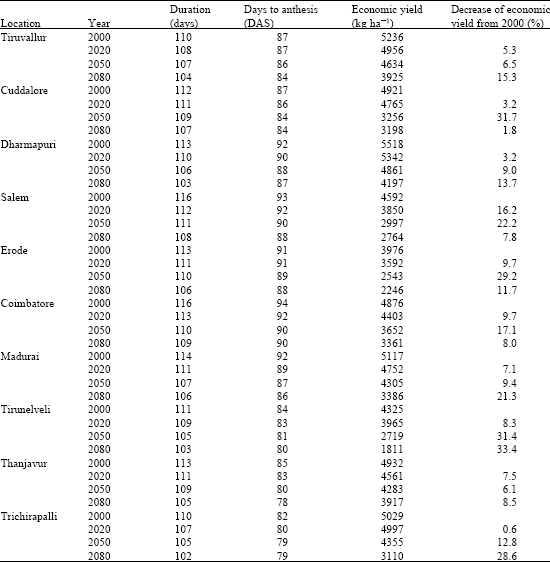 | |
Each crop requires a specified growing degree days. With the increase in temperature, the requirement of GDD will be met in a shorter period which results in reduction in crop duration. Similar results were reported by Venkataraman (2004). As the duration decrease, the number of days to anthesis also gets advanced (Table 1).
Leaf Area Index (LAI)
As the year advances, the simulated LAI also showed diminution at different growth stages. At initial stages of the crop growth, much difference was not seen with respect to LAI between 2000, 2020, 2050 and 2080. In 2000, at 30 DAS, the LAI was 0.14, which reduced to 0.12 in 2020, 0.08 in 2050 and to a great level (0.05) from 2000 in 2080 at Cuddalore (Fig. 1).
The reduction in LAI might be due to the negative impact of high temperature on leaf growth. Every crop requires certain level of critical temperature for its growth. Increase in temperature beyond that level, the crop growth decreases by loosing its cell integrity as stated by Narendra and Sunitha (2005).
Dry Matter Production (DMP)
There was a steady decrease in DMP from 2000-2020, 2020-2050 and 2050-at each interval of ten days and this rate of decrease was observed to be quite high from 2050-2080 (Fig. 1).
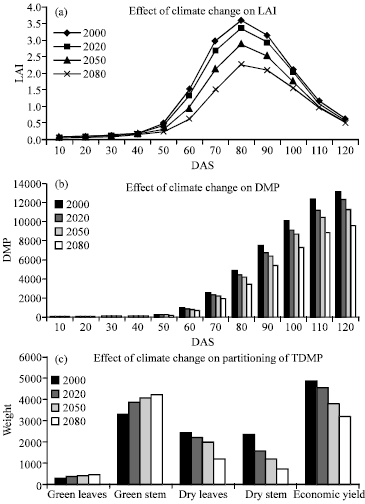 | |
| Fig. 1: | Effect of climate change on LAI (a), DMP (b) and partitioning of TDMP (c) in Rice |
This reduction in DMP might be due to the cumulative effect of increased temperature, decreased crop duration, reduction in LAI coupled with changes in rate of photosynthesis. Manickasundaram (1992) has reported reduced DMP as a result of increase in temperature.
Partitioning of TDMP
It plays a major role in yield improvement. As the year advances from 2000 to 2080, the CO2 concentration increases and the mean temperature decreases and precipitation varies. This change leads to an average increase in weight of green leaves (10 to 50 kg ha-1 from 2020 to 2050 and 40 to 100 kg ha-1 from 2050 to 2080) and green stem (3281.5 kg ha-1 in 2000, 3840.1 kg ha-1 in 2020, 4056.7 kg ha-1 in 2050 and 4215 kg ha-1 in 2080) and decrease in weight of dead leaves from 2439.7 kg ha-1 (2000) to 1170.3 kg ha-1(2080) and dead stem from 2329.7-689.81 kg ha-1 during 2000 and 2080 respectively (Fig. 1). The temperature increase due to global warming augments the transpiration and respiration processes. As the availability of water is less due to increased transpiration, mobility of nutrients is affected and the photosynthates will not be effectively transported from source to sink. This was also reported by Narendra and Sunitha (2005).
Economic Yield
The simulated rice yield showed a reduction in future years and this might be due to the reduction in life-duration of the crops as stated by Lal et al. (1998). The percentage of decrease in yield from 2000-2020, 2020-2050 and 2050-2080 ranged from 0.6-16.2%, 6.1-31.7% and 1.8-33.4%, respectively in the selected study locations (Table 1). The positive effects of increase in CO2 concentrations on growth and yield are nullified by simultaneous increase in temperature. Venkataraman (2004) have reported increased cloudiness under elevated CO2 concentrations which will have impact on incoming solar radiation as well as on photosynthetic rate. For a given crop and location, the reduction in yield is likely to be directly proportional to reduction in solar radiation. Studies conducted on rice crop at Andhra Pradesh and Punjab by Yogeswara Rao (1999) and Hundal and Kaur (1996) respectively revealed that 10% decrease in solar radiation due to overcast skies would result in an increase of 1ºC in mean temperatures, thus increasing the maintenance respiration by 1% and hence reduction in crop yield.
Yield Parameters
Yield reduction is generally accredited to reduction in yield attributing parameters which in turn decide the economic yield of the crop. Number of grains per meter square decreased from 2000 to 2020, 2050 and 2080 due to change in temperature and precipitation. Increase in temperature at anthesis might result in poor anther dehiscence and pollen shedding, thus reducing pollination and grain number. This is in conformity with the findings of Mackill et al. (1982) and Zheng and Mackill (1982). It was interesting to notice that the change in temperature and precipitation did not influence the test weight of grains as this parameter is genetically driven.
CONCLUSIONS
From the results of the study, it could be seen that the projection on future climate indicate alarming increase in both maximum and minimum temperature coupled with variability in rainfall which will have greater impact on crop production. Crop duration will be shortened and anthesis dates are expected to get advanced. There might be inefficient translocation of photosynthates, reduction in yield attributing characters and in turn huge reduction in the productivity of the crops. To meet the food needs of the growing population, it is necessary to tailor the management options such as shifting sowing window, growing heat tolerant varieties etc., to overcome the ill effects of changing climate.
REFERENCES
- Fengmei, Y., X. Yinglong, L. Erda, Y. Masayuki and Z. Jiahua, 2007. Assessing the impacts of climate change on rice yields in the main rice areas of China. Climate Change, 80: 395-409.
CrossRefDirect Link - Gadgil, S. and S.P.R. Rao, 2000. Farming strategies for a variable climate. Curr. Sci., 78: 1203-1215.
Direct Link - Lal, M., K.K. Singh, L.S. Rathore, G. Srinivasan and S.A. Saseendran, 1998. Vulnerability of rice and wheat yields in NW India to future changes in climate. Agric. For. Meterol., 89: 101-114.
CrossRefDirect Link - Mackill, D.J., W.R. Coffman and L.J. Rutger, 1982. Pollen shedding and combining ability for high temperature tolerance in rice. Crop Sci., 20: 730-733.
Direct Link - Naylor, R.L., D.S. Battisti, D.J. Vimont, W.P. Falcon and M.B. Burke, 2007. Assessing risks of climate variability and climate change for Indonesian rice agriculture. Proc. Natl. Acad. Sci. USA., 104: 7752-7757.
CrossRefPubMedDirect Link - Rao, Y., 1999. Simple biometeorological model for yield forecasting of lowland rice in Andhra Pradesh. Proceedings of the National Workshop on Dynamic Crop Simulation Modeling for Agrometerological Advisory Services in India, January 4-6, 1999, Department of Science and Technology, New Delhi, pp: 305-311.
- Venkataraman, S., 2004. On possible reduction in yields of grain crops in future climate. J. Agrometeorol., 6: 213-219.
Direct Link
Deepak Upadhya Reply
I want to do study on economic analysis of climate change in cereals. Especially on Rice so, for this i want to read the full article of this research is it possible to send me to my given e-mail adress.