

Murali Raman
Multimedia University, Malaysia
Maniam Kaliannan
Universiti Teknologi MARA (UiTM)
Cheng Ming Yu
Multimedia University, Malaysia
Information Technology Journal
Year: 2007 | Volume: 6 | Issue: 3 | Page No.: 428-434







ABSTRACT
E-business is global business. Although technological advancement and high connectivity in the developed nations promised sound returns to firms engaged in the E-business, to realize optimum benefits from E-businesses, it requires active participation of all nations round the world. Governments worldwide are faced with the challenge of transformation and the need to reinvent government systems in order to deliver efficient and cost effective services, information and knowledge through information and communication technologies. There is an ever increasing role and demand for successful implementation of E-business and E-government initiatives within developing nations. It is essential to examine problems or barriers experienced by developing countries in their quest for developing sound E-business and E-government framework. Thus, Malaysia is chosen as the case study for this purpose. Malaysia is a fast transforming country with reference to E-business and E-government initiatives. However, before Malaysia can maximize the true value potential of E-business and E-government initiatives, issues such as creating more awareness amongst citizens ‘vis and vis’ E-business and E-government applications, enhancing collaboration between government and corporations and improving existing technical infrastructure, must be given further consideration.
PDF Abstract XML References Citation
How to cite this article
Murali Raman, Maniam Kaliannan and Cheng Ming Yu, 2007. E-business and E-government: Issues and Challenges in Malaysia. Information Technology Journal, 6: 428-434.
DOI: 10.3923/itj.2007.428.434
URL: https://scialert.net/abstract/?doi=itj.2007.428.434
DOI: 10.3923/itj.2007.428.434
URL: https://scialert.net/abstract/?doi=itj.2007.428.434
INTRODUCTION
E-business is a term broadly used to express various commercial activities conducted through Internet, extranet and intranet such as E-shopping, E-education, E-banking, E-financing, etc, is on the fast track of becoming the most popular used cliché. In the E-business world, firms in the North American region, particularly the United States, are labeled as the leaders to conduct their businesses over the Net. However, it is estimated that these North America-based web sites could reach only 5% of the world’s population and 25% of global purchasing power (Davenport, 2000).
E-business deals with connectivity, where the state of the communications infrastructure is eminently important. Connectivity is also the main activity that developing countries are seriously lacking that they are struggling to build and to catch up with the developed nations. Without adequate access to connectivity, the construction of a successful E-business world could hardly be a reality. Realizing fact that there is a big gap between the developed and developing nations in terms of the readiness of IT infrastructure for E-business, many efforts carried out at the international level by international organizations have been conducted. For instance, the UN Development Program and the private Markle Foundation have recently launched a two-year effort, called the Global Digital Opportunity Initiative, to help 12 underdeveloped economies build or improve their IT infrastructure (EIU Forum, 2002).
How can the global E-business architecture be constructed so that it will eventually lead all nations to develop their own national E-business model in order to merge into the new business world and compete more efficiently? What is the role of the governments in stimulating E-business initiatives in the context of developing nations? How can E-government initiatives complement successful E-business models? What factors drive successful E-business and E-government models within developing nations? These questions motivate the writing of this paper.
In order to examine the issues mentioned earlier, it is imperative to look at the problems, barriers or obstacles experienced in the developing nations in implementing an effective E-business and E-government practices. Internet is global and connectivity is global, but local conditions matter.
E-business defined: Seth and Rajendra (1997) cite that globalization, rapid development in technology and rising consumer expectation for product and service quality on all accounts are factors that led many conventional businesses to rethink their respective business models (Seth and Rajendra, 1997). To succeed in ever increasing competitive conditions, it is vital for businesses to offer superior business models (Kalakota and Winston, 2001; Seth and Sisoda, 1997; Peterson et al., 1997) i.e., delivery of products and service at the convenience of consumers, not sellers. Access to bandwidths, increase in level of technical sophistication and ever increasing processing capability of electronic mediums (Seth and Rajendra, 1997; Hoffman et al., 1996) are driving forces for the possible exponential growth of online buying behavior.
Specifically, Seth and Rajendra (1997) the following factors as forces driving changes in consumer behavior by examining both supply and demand side of the marketing equation.
Supply side:
| • | Enhancement in product technology, e.g., through utilization of CAD/CAM techniques, JIT system which to the consumers these outcomes translate to greater manufacturing and service distribution efficiency, significant increase in level of customization and overall increase in product/service delivery choices for consumers. |
| • | Enhancement in Distribution technology e.g., POS, EDI and Computer Assisted Logistics (CALS). These technologies are capable of reducing inventories, minimize defects while improving overall efficiency of logistics and warehousing transportation systems. |
Demand side
Stemming from a macro perspective, key factors changing overall nature of consumer buying behavior and demand for products and services are:
| • | Declining growth rate for new born babies globally, |
| • | Rising levels of middle aged people in developed nations e.g. Japan and USA, |
| • | Increasing levels of women forming the workforce in many economies of the world, |
| • | Continuous changes in lifestyles, income levels and ethnic diversity (Seth and Rajendra, 1997). |
These forces cumulatively resulting into issues such as higher stress levels amongst consumers, more concern on privacy and individual rights and focus on public safety.
Based on the demand pull and supply push, conventional business models in developed nations are slowly being replaced by more advanced and sophisticated electronic based (E-business) models. In a highly simplistic manner, E-business can be defined as the combination of business processes, infrastructure, human resources and entrepreneurial idea/concept that are combined together to produce a superior or high performing business model. The word “superior” model here refers to a business that is able to offer goods and services to consumers at a significantly higher speed, lower cost than before on most cases, at locations throughout the world and at anytime consumers intend to purchase the good and/or services (Kalakota and Marcia, 2000; Bakos, 1991; Burke, 1997; du Plessis and Boon, 2004).
E-business has become a standard method of operations for many companies throughout the world. Establishing and operating an E-business, particularly one that involved significantly large volumes of transactions, requires cross-functional expertise e.g., technical, marketing, customer relations and advertising skills. Examples of traditional sectors that have utilized information and communication technology to redesign strategy and product/service offering are banking and finance, print and publication, education, manufacturing and retail.
As a result, society in general is able to pay bills, write cash checks, apply for loans, open banking accounts, trade stock, mortgage homes and manage their assets and daily chores online. Increasingly, hard cash (money) is being replaced by technology that offers greater convenience e.g., smart cards and digital cash. In more advanced countries, all consumers require to shop and fulfill other daily payment related obligation is Internet connectivity, a computer and any form of digitally accepted payment. And from a distribution point of view, the role of Internet (with emphasis on a greater degree of virtualization to offer consumers with the benefit of E-business services) and web based models are seen to be rapidly growing amongst the developed nations e.g., US and Europe.
E-government defined: E-government is defined as a way for governments to use the most innovative ICT, particularly Web-based Internet applications, to provide citizens and businesses with more convenient access to government information and services, to improve the quality of the services and to provide greater opportunities to participate in democratic institutions and processes (Fang, 2002). He argues further that, this includes transactions between Government and Business (G2B), Government and Citizen (G2C), Government to Employee (G2E) and among different units and levels of government.
E-government is not just about government web pages and E-mail. It is not just about service delivery over the Internet (Donnelly and McGruirk, 2003). It is not just about digital access to government information or electronic licensing and payment. Harris states that the challenge for E-government will be to incorporate governance itself and shift the way political and social power is organized and used’. In other words, the challenge for E-government will be to do the following:
| • | Provide citizens with access to government information |
| • | Deliver government services to citizens |
| • | Provide a portal for processing government information between citizens and businesses with government |
| • | Facilitate citizen participation in government, creating digital citizens in a digital democracy |
Government in an E-business context: Figure 1 provides an illustration of the role of governments in an E-business context. To enhance E-business activities within an economy, governments can play a dual role. The first role is to facilitate and nurture E-business initiatives within the economy. This includes facilitation in terms of providing the relevant infrastructure, talent/skills development initiatives, favorable policies (e.g., taxation, rules and regulations) that support the growth of E-business. In the case of Malaysia, the facilitation process is done, for example through various guarantees given to businesses that intend to establish E-business initiatives, under the multimedia super corridor master plan (http://www.mdc.com.my).
Apart from playing the role of facilitators, governments can also become active participants of an E-business initiative. For example, governments can use electronic procurement solutions, when dealing with its suppliers. In Malaysia, this is done through a project called E-perolehan (http://home.eperolehan.com.my/en/default.aspx).
E-perolehan is an electronic procurement system. It facilitates the procurement activities for the government of Malaysia, by streamlining the procurement activities. The system is driven by the Electronic Data Interchange (EDI) process. The E-perolehan system enables among others,
| • | Suppliers to display their products on the world wide web |
| • | Receive, manage and process purchase orders and receive payment from government agencies via the Internet (http://home.eperolehan.com.my/en/about/overview3. aspx) |
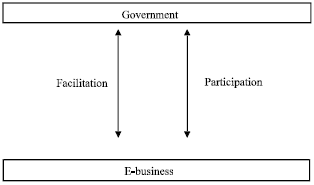 | |
| Fig. 1: | Government and E-business |
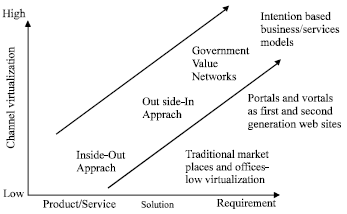 | |
| Fig. 2: | Changing nature of business environments |
Figure 2 shows the changing nature within business environments. Key lessons from the framework above are summarized as follows. Initially, governments and businesses globally took and insidE-out approach to business and government services rendered. Businesses sold products based on what was manufactured. In terms of distribution channel, there was very low level, of online/virtual channels being used. Governments on the other hand offer various services to business and participate in transaction such as procurement through traditional mechanisms.
Demand for products and government services were based on products that were available in traditional market places. Then came the marketing and selling wave based on what consumers wanted i.e. manufactures are taking an outsidE-in approach i.e., they manufacture what solution(s) customers are looking for in a product. Products/services are also made available online to increase convenience for buyers. Governments too, particularly in Western societies, launched first and second generation web portals to offer various services to businesses and societies in general. This has led to leading edge Internet driven business strategies that have given birth to Portals and Vortals (Vertical Portals). Demand from customers is based on how products/services can offer solution to daily problems.
The next wave will lead E-business into greater heights. Companies will involve all partners in its supply chain to find out exactly, what the intention of every customer is. This is why, intention based portals are emerging. Demand for products will be based on what consumers’ intent to have i.e., what they want, when they want it and how they want it. And the challenge for managers in making sure that they proactively respond to competition is in obtaining accurate information about customer intentions.
In a similar fashion, to respond proactive to the changing nature within the business sector, governments need to move rapidly into the E-space and create value added service and engage in strategic partnership with businesses. This could pave the way towards a concept called Government Value Networks (GVNs). GVNs could foster intention based business models i.e., governments and their respective business counterparts, engaging in intentions based business/service models- i.e., accurate understanding of each others requirements. The information and transactional flow within the GVNs is expected to be more efficient. Examples are Business-to-Government procurement systems in Malaysia, via a project called E-perolehan (E-procurement).
To be able to respond to changing competitive pressures, tightly integrated E-business architecture is important. To succeed in the future, both businesses and governments are required to establish flexible and scaleable E-business and E-government architectures that can:
| • | Improve customer service and overall operations quality through company wide integrated applications, |
| • | Better link technology to business/government objectives |
| • | Establish applications at a faster pace |
| • | Establish/build E-business and E-government applications that require minimal amount of training or cultural change and |
| • | Achieve superior standard for overall company wide performance (Gates, 2000) |
E-business and E-government landscape in Malaysia: The E-business and E-government landscape in Malaysia, was initiated primarily through the Multimedia Super Corridor (MSC) project, launched in 1996, by former Prime Minister of Malaysia, Tun Mahatir Mohammed. The MSC story began alongside the Vision 2020 goals within Malaysia. The Vision 2020 statement is a national objective and commitment to assist Malaysia in becoming a fully developed nation by the year 2020.
Malaysia is rapidly loosing its competitive advantage to other emerging economies within the region. The government in 1996 recognized soon thereafter that bringing Malaysian average income up to that of a fully developed state by 2020 (estimated to be about US$10,500) will not be achieved by focusing mainly on significant increases in manufacturing (projected to grow by approximately 7% per year and topping out at 38% of GDP in the mid-1990’s). To enhance Malaysian wages to that of a fully developed country would require another strategy and another engine of economic growth. Hence, the MSC was launched in 1996.
The MSC is considered a long-term strategic initiative (1996-2020) which involves the partnership between the Government (as the chief architect of its vision) and the private sector (as the main drivers for its implementation). This reflects that the creation of MSC is a necessity, as the new engine of growth for the economy as well as to ensure Malaysia is moving in tandem with the rest of the world in embracing the IT revolution. Basically, the MSC is a dedicated corridor (15 kilometers wide and 50 kilometers long) which stretches from the Kuala Lumpur City Center in the north to the new Kuala Lumpur International Airport (KLIA) in the south. Besides offering the ICT initiatives, the corridor aims to attract the world’s leading ICT companies to locate their multimedia industries, undertake R&D, develop new products and technologies and export from this corridor as their base. The corridor is also providing the ideal growth environment for the local entrepreneurs to transform themselves into world-class companies. These companies would be given the MSC status, which entitles them to a series of benefits, as per guided by the bill of guarantees (http://www.mdc.com.my).
A total of seven flagship areas were launched within the MSC. These are:
| • | Electronic government |
| • | National multipurpose card (MyKad) |
| • | Smart school |
| • | Telehealth |
| • | R&D clusters |
| • | E-business |
| • | Technopreneur development |
E-government initiatives in Malaysia: The Malaysian Administrative Modernization and Management Planning Unit (MAMPU) has started laying the groundwork to initiate nine strategic initiatives to kick off the Public Sector ICT Strategic Plan (The Star, 27/10/2003). The aim of the initiatives is to enable all government agencies to operate in a fully integrated electronic environment. The identified nine strategic initiatives are:
| • | Citizen centric portal |
| • | Business community portal |
| • | Local government system |
| • | Land and property system |
| • | Online income tax |
| • | Integrated financial management system |
| • | Government to employee portal |
| • | E-learning |
| • | E-social services |
For the year 2004/2005, the government’s focus would be on rolling out more pilot projects nationwide and the implementation of E-court and E-land (The Star Press, 2003). The E-procurement project is expected to be rolled out to 3 500 government procurements sites nationwide in addition to current 1,500 sites that are already connected. The Generic Office Environment (GOE) project would be rolled out to 14 agencies with a base of more than 2,000 users. The Human Resource Management Information System (HRMIS) project, once implemented in the 10 pilot agencies would be rolled out to all other agencies nationwide in stages. In addition, there will be some services which will be improved in year 2004/2005 such as:
| • | Road Transport Department (RTD) summons enquiry and payment services |
| • | RTD Learners Drivers’ License issuance and renewal services |
| • | Electronic scheduling and theory test |
| • | Royal Malaysian Police traffic summons/enquiry services |
| • | Tenaga Nasional and Telekom Malaysia: utility bill enquiry and payment services |
Issues within E-business initiatives: Malaysia’s global ranking in terms of its E-readiness has declined. In 2004, Malaysia was positioned 33rd in the ranking is classified as the followers in E-business framework. However, in the 2005 E-readiness report published by the Economic Intelligence Unit, Malaysia is currently ranked 35 in the global E-readiness ratings (Economic Intelligence Unit, 2005).
To further enhance Malaysia’s ability to compete on a global basis given the advent of Knowledge Economy and new business architecture, the relevant policy makers can adopt several key measures. Firstly, prE-requisites for successful development of E-business and E-commerce applications must be in place. In this context, rapid development of infrastructure and skills to meet the demands of a new economy has to be in place. Efforts such as creation of knowledgE-based society should be given priority in every five-year economic master plan. Secondly, Small and Medium Size Enterprises (SME’s) in Malaysia should be encouraged and led to joint ventures and collaborative partnerships with global players involved in similar activities. In this context, efforts within the MSC e.g., venture capital funding, grant schemes and establishment of Incubator centers should continue.
There is need for greater collaboration and smart partnership between the world of academia and corporate sector in Malaysia. In this context, issues such as competitive reward schemes for research and local publication in addition to development of prototype business models could be established. In other words, we need to raise both the level and standard of research conducted in Malaysia to assist all efforts in creating strong base of knowledge workers. On a similar note, greater collaboration between both public and private institution of higher education and the corporate sectors is encouraged. In this regard, the role of practical training and education syllabus based on demands/requirements of a Knowledge based economy needs to be established. Thirdly to propel E-business and E-commerce, efforts to ensure that issue such as limited public awareness, rapid development of Cyberlaws, privacy and online transaction security needs to be addressed.
Issues within E-government initiatives: Despite early leadership, Malaysia’s E-government initiatives face major challenges in moving to higher level of maturity and impact. Major factors include:
| • | Lack of broadband infrastructure hindered roll out |
| • | Low usage of Mykad beyond identity functions |
| • | Slow adoption of E-government applications due to lack of integration and insufficient engagement of key stakeholders (especially users and citizens). |
| • | Low PC ownership and low ICT literacy among the members of the society. |
| • | The information provided by government agencies via the E-government sites is stale and not current. |
| • | The sites are not easy for the novices to navigate. |
| • | Implementation of Telehealth did not succeed due to inadequate change management and inappropriate Build Own Operate business model. |
The need for educational reform at all levels i.e., primary, secondary and university education in order to create a knowledgeable society (Hazman et al., 2003).
Implication to theory and practice: Successfully realizing the vision for E-government means fundamentally changing how government operates and implies a new set of responsibilities for public servants, businesses and citizens. The new services, information and channels for government to interact with the different constituencies will require all parties to become familiar with new technologies and develop new skills. The landscape of the E-government applications as follows:
E-government will encompass the entire gamut of government operations, impacting citizen-government (C2G), business-government (B2G) and government-government (G2G) transactions. The important benefit from implementing E-government is the applicability of services to a large cross section of end-users, improve the quality of services, be cost-effective and demonstrate real productivity gains for government. However, the following factors are crucial to ensure successful E-business and E-government initiatives for developing nations, based on our experience in Malaysia:
| • | The existence of clear objectives for E-government and E-business initiatives by the government. |
| • | The ability of governments to nurture small and medium size enterprises (SMEs) in utilizing and E-business and E-government applications. Overtime, through this process, assist the SMEs to become regional and eventually world class players. |
| • | The ability of governments to streamline the national education policies to ensure that nations are equipped with sufficient knowledge workers required to support and sustain E-business ventures. |
| • | The ability of governments to invest in relevant infrastructure such as broadband technology and make this accessible and affordable to the business communities. |
| • | Awareness of both business and governments about the existence of information and communication technologies that can streamline business and government service processes. |
CONCLUSIONS
Several pre-requisites for successful development of E-business and E-government applications must be in place, in the context of developing nations. Firstly, rapid development of infrastructure and skills to meet the demands of a new economy has to be in place. Efforts such as creation of knowledgE-based society should be given priority in every five-year economic master plan.
To ensure successful deployment of E-business and E-government initiatives in the small and medium size enterprises (SME’s), should be encouraged and led to joint ventures and collaborative partnerships with the government of Malaysia. In the case of E-perolehan in Malaysia, greater collaborative efforts between the SMEs and the Malaysian government are needed before the true value of this E-procurement system can be realized.
There is also a need for greater collaboration and smart partnership between the world of academia and corporate sector to proper E-business and E-government initiatives. In this context, issues such as competitive reward schemes for research and local publication in addition to development of prototype business models could be established. In other words, in the case of Malaysia, there is a need to raise both the level and standard of research conducted in Malaysia to assist all efforts in creating strong base of knowledge workers. On a similar note, greater collaboration between both public and private institution of higher education and the corporate sectors is encouraged. In this regard, the role of practical training and education syllabus based on demands/requirements of a Knowledge based economy needs to be established. Only then, can the value proposition of E-business and E-government initiatives be experienced in Malaysia.
REFERENCES
- Burke, R.R., 1997. Do you see what I see? The future of virtual shopping. J. Acad. Market. Sci., 25: 352-360.
Direct Link - Donnelly, P. and T. McGuirk, 2003. Electronic delivery of public services in the United Kingdom: The case of the mersyside fire service and fire service direct. Asian J. Public Administrat., 25: 185-208.
Direct Link - Fang, Z., 2002. E-Government in digital era: Concept, practice and development. Int. J. Comput. Internet Manage., 10: 1-22.
Direct Link - Hoffman, D.L., D.K. William and P.N. Thomas, 1996. Internet and web use in the US. Commun. ACM, 39: 36-46.
Direct Link - Peterson, R.A., S. Balasubramaniam and J.B. Bart, 1997. Exploring the implications of the internet for consumer marketing. J. Acad. Market. Sci., 25: 329-346.
Direct Link - Du Plessis, M. and J.A. Boon, 2004. Knowledge management in eBusiness and customer relationship management: South African case study findings. Int. J. Inform. Manage., 24: 73-86.
CrossRefDirect Link