

Henry Asumadu
CSIR-Crops Research Institute, P.O. Box 3785, Kumasi, Ghana
M. B. Ewool
CSIR-Crops Research Institute, P.O. Box 3785, Kumasi, Ghana
K. Obeng-Antwi
CSIR-Crops Research Institute, P.O. Box 3785, Kumasi, Ghana







ABSTRACT
Maize is one of the world’s three primary cereal crops and also one of the most popular food crops on the domestic market in Ghana. Erratic rainfall pattern in the Forest-Savannah transition zone of Ghana for the past decade has caused shortfalls in rainfall amounts resulting in low maize production and productivity. The Maize Breeding Programme at the Crops Research Institute, Ghana, in collaboration with the International Institute of Tropical Agriculture, Ibadan, Nigeria identified high yielding and drought tolerant open-pollinated and hybrid maize varieties for evaluation and eventual release to farmers. The mother-baby trial model was adopted for the evaluation of these varieties in the major season of 2009 in three farming communities in the target agro-ecology. The Farmers variety showed poor yield performance in both the mother and baby trials and in the ranking of varieties by farmers and researchers in both early and medium maturity groups. Almost all the improved varieties were appreciated by both researchers and farmers. The yields of the drought tolerant varieties in both normal and drought affected environments were higher than the farmers variety in both cases. The two most promising drought tolerant varieties, TZE-W Pop STR QPM C0 and IWD C2 SYN F2 out-yielded the Farmers’ variety by as much as 23 to 90% across locations. Therefore, these varieties were recommended by the Maize Breeding Programme at the Crops Research Institute to the National Variety Release Committee of Ghana for release to farmers in 2010.
PDF Abstract XML References Citation
Received: May 23, 2011;
Accepted: August 05, 2011;
Published: September 27, 2011
How to cite this article
Henry Asumadu, M. B. Ewool and K. Obeng-Antwi, 2011. Participatory Evaluation of Drought Tolerant Maize Varieties using Mother-Baby Trial Model: A Case Study in the Forest-Savannah Transition Zone of Ghana. Journal of Agronomy, 10: 68-73.
DOI: 10.3923/ja.2011.68.73
URL: https://scialert.net/abstract/?doi=ja.2011.68.73
DOI: 10.3923/ja.2011.68.73
URL: https://scialert.net/abstract/?doi=ja.2011.68.73
INTRODUCTION
Maize is one of the world’s three primary cereal crops. It occupies an important position in world economy and trade as food, feed and industrial grain crop. It is one of the most popular food crops on the domestic markets in Ghana and is grown in all the agro-ecological zones of the country. It is the basis of several food preparations and the main feedstuff for poultry and other livestock. A total area of 954,000 ha was cultivated under maize in 2009 with a total production of 1.62 million metric tons mainly by small scale farmers who use a low level of technology with an average yield of 1.7 mt ha-1 (Ministry of Food and Agriculture, 2010). The policy of the Ministry of Food and Agriculture of Ghana is to promote and encourage increased production through intensification rather than land expansion (Ministry of Food and Agriculture, 2002).
In general, maize planted on good soils need at least 500-700 mm of well distributed rainfall during the season (Taba and Twumasi-Afriyie, 2008; Department of Agriculture, Forestry and Fisheries, 2008). For the past decade, at least one of the seasons in the bimodal rainfall pattern exhibited in the Forest-Savannah transition zone of Ghana has experienced shortfalls (less than 500 mm) in rainfall amounts coupled with poor distribution. The introduction of drought tolerant maize varieties in this zone was therefore imperative to increase maize production and subsequently alleviate hunger and poverty of farmers.
The Maize Breeding Programme at Crops Research Institute (CRI), Ghana, in collaboration with the International Institute of Tropical Agriculture (IITA), Ibadan, Nigeria, identified high yielding and drought tolerant open-pollinated and hybrid maize varieties in their regional variety trials. Therefore, there was the need for further on-farm evaluation and eventual release to farmers. Considering the fact that the ultimate beneficiaries of these promising varieties were farmers it was necessary to have them involved in the evaluation and selection of suitable materials under their circumstances. The mother-baby trial model adopted for this project consisted of researcher-managed mother trial comprising of promising new varieties and farmer-managed baby trials which contained few varieties from the mother trial (De Groote et al., 2002). It is a decentralized approach to on-farm research that greatly improves the timeliness of sowing, trial supervision and contact with farmers (Banziger and de Meyer, 2000). Research costs can be reduced and adoption rates increased if farmers are allowed to participate in variety testing and selection (Yadaw et al., 2006). Researchers necessarily discard many varieties during evaluation and selection process because of traits considered undesirable; however, these seemingly undesirable traits could be of interest to farmers (Bellon, 2002). This illustrates the communication gap between researchers and farmers. The importance and complex nature of agricultural research demands coordinated effort among biological scientists, extension agents and farmers in order to ensure that appropriate technology is developed and promoted (Rao et al., 2004).
The objectives of the project were to: (1) involve farmers’ in the evaluation and selection of drought tolerant open-pollinated and hybrid maize varieties by the use of mother-baby model approach to on-farm research and (2) provide data to support the Maize Breeding Programme of CRI, Ghana for the eventual release of these varieties to farmers.
MATERIALS AND METHODS
One mother trial each of early and medium maturing maize varieties and five or six baby trials each were planted in the major season of 2009 in farming communities at Techiman, Wenchi and Kintampo in the forest-savannah transition zone of Ghana. The early and medium maturing maize varieties take 90-95 and 105-110 days to reach harvest maturity, respectively. The early maturing mother trial contained four varieties namely, 2004 TZE-W Pop STR C4, 2004 TZE-Y Pop STR C4, TZE-W Pop STR QPM C0 and Farmers’ variety. The medium maturing mother trial contained five entries namely, DT-SR-W C0 F2, IWD C2 SYN F2, DT-SYN-1-W, Mamaba and Farmers variety. The experimental design for the Mother trial was a randomised complete block with three replications per site. Each plot consisted of six rows, 75 and 80 cm apart for early and medium varieties, respectively. Each row was 6 m long and the distance between plants within a row was 40 cm for both maturity groups. Baby trials were not replicated and contained two drought tolerant varieties and Farmers’ variety with 20 m by 20 m plot size each. Varieties used in the baby trials were selected by farmers from the mother trials. Data on plant establishment and days to 50% anthesis and silking were taken and grain yield was calculated at 15% moisture content and at 80% shelling percentage.
Farmer field days were organised at various mother trial sites about one week prior to harvest. Representative farmers who were invited to the field days were requested to select their preferred varieties and rank them based on their own selection criteria with due consideration of the following parameters in the order of importance (e.g., grain type, maturity group and variety reaction to biotic and abiotic stresses). Genstat 5 Release 3.2 (PC/Windows 95) was used for all statistical analyses.
Where the ANOVA showed significant differences (p<0.05) of variables (e.g., days to 50% anthesis and silking, grain yield, etc.) between treatments (varieties), the Standard Errors of Differences of means (SED) were used to compare between treatments. The relations between grain yields of the best improved variety of the two maturity groups and Farmers variety across different environments were investigated by regression analysis.
RESULTS
Early maturing drought tolerant mother and baby trials: Significant (p<0.05) differences were observed between varieties in Days to 50% Anthesis (DFA) and Days to 50% Silking (DFS) (Table 1). Anthesis and silking in the farmers variety were late at 57 and 60 days after planting, respectively, while the improved drought tolerant early maturing varieties took 48-50 and 53-55 days, respectively, to reach mid-anthesis and mid-silk across locations. The lateness of the farmers’ variety in anthesis and silking and subsequently in maturity did not translate into higher yield as expected. Surprisingly, the early maturing drought tolerant variety TZE-W Pop STR QPM C0 (4266 kg ha-1) out-yielded the farmers’ variety (3479 kg ha-1) by 23% across locations (Table 1). The other two improved varieties, 2004 TZE-W Pop STR C4 (3951 kg ha-1) and 2004 TZE-Y Pop STR C4 (3804 k ha-1) also out-yielded the Farmers’ variety by 14 and 9%, respectively.
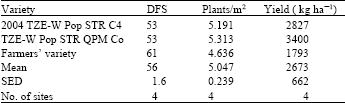
In the baby trials which were managed by farmers the improved drought tolerant maize varieties again out-yielded the Farmers variety in all the four locations at Kintampo and Wenchi (Table 2). Here also, the Farmers variety (1793 kg ha-1) was late in silking (61 d) as compared to the drought tolerant varieties of 53 d. However, TZE-W Pop STR QPM C0 (3400 kg ha-1) and 2004 TZE-W Pop STR C4 (2827 kg ha-1) out-yielded the Farmers’ variety by as much as 90 and 58%, respectively. Plant stand establishment of the farmers’ variety was however lower than the improved variety (Table 2).
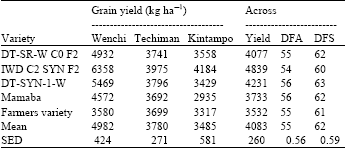
Medium maturing drought tolerant mother and baby trials: In the mother trial, significant (p<0.05) differences were observed between varieties in DFA, DFS and in grain yield (Table 3). The highest yielding variety IWD C2 SYN F2 (4839 kg ha-1) out-yielded the Farmers variety (3532 kg ha-1) and the released hybrid variety, Mamaba (3733 kg ha-1) which was used as the standard check by 37 and 30%, respectively, across locations (Table 3).
| Table 1: | Grain yield (kg ha-1), days to 50% anthesis (DFA) and days to 50% silking (DFS) of three early maturing drought tolerant maize and farmers’ varieties tested across three locations in the mother trial |
 | |
| Table 2: | Days to 50% silking (DFS), plant density and grain yield (kg ha-1) of early maturing maize Baby trials planted at Kintampo and Wenchi Farming communities |
 | |
The other two drought tolerant varieties DT-SR-W C0 F2 (4077 kg ha-1) and DT-SYN-1-W (4231 kg ha-1) also significantly (p<0.05) out-yielded the farmers’ variety but not Mamaba.
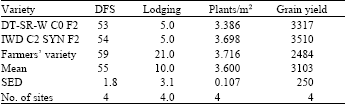
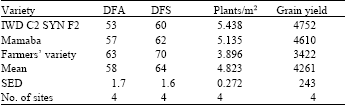
In the baby trials the improved drought tolerant maize varieties DT-SR-W C0 F2, IWD C2 SYN F2 and Mamaba produced significantly (p<0.05) higher yields than the Farmers variety in eight locations in the Techiman, Kintampo and Wenchi farming communities (Table 4, 5). The farmers planted full season or late maturing varieties which took 63 and 70 d to tassel and silk as compared to the medium maturing improved varieties of 53-57 and 60-62 d, respectively (Table 5). The Farmers’ varieties were also taller and therefore were more prone to lodging (21%) than the improved varieties (5%). Plant stand establishment of the Farmers’ variety (3.716 plants m-2) was significantly (p<0.05) better than the improved variety DT-SR-W C0 F2 (3.386 plants/m2 at Kintampo and Techiman but did not translate into higher grain yield of the former variety (Table 4). Plant density of the Farmers variety at Wenchi was however lower than the improved varieties (Table 5).
Regression of the grain yield of the most promising early TZE-W Pop STR QPM C0 and medium IWD C2 SYN F2 varieties on to the Farmers variety (Fig. 1, 2) was significant (p<0.01) with R2 of 0.76 and 0.65 for TZE-W Pop STR QPM C0 (early) and IWD C2 SYN F2 (medium), respectively. The regression coefficients of the two drought tolerant varieties were 0.78±0.204 and 0.82±0.242, respectively (Fig. 1, 2).
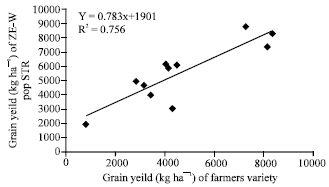 | |
| Fig. 1: | Relation between grain yield (kg ha-1) of drought tolerant variety TZE-W Pop STR QPM Co and Farmers’ variety |
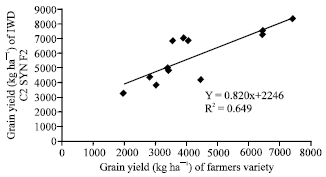 | |
| Fig. 2: | Relation between grain yield (kg ha-1) of drought tolerant variety IWD C2 SYN F2 and Farmers’ variety |
Farmers’ perception about the varieties: An average of 25 farmers attended each field day at the mother trial sites. The parameters of most interest to the farmers were grain yield, grain size, cob size, grain colour, grain texture, earliness, plant height, drought tolerance and marketability. These parameters were ranked in all three locations in a 1-9 scale of importance, 1 being the most preferred and nine the least preferred (Table 6). The mean scores from the three locations indicated that the three most important selection criteria for the farmers were grain size (2), grain yield (3) and cob size (3.7). The parameters of intermediate importance were seed texture (5), marketability (5.3) and earliness (6). Seed colour (6.3), drought tolerance (6.7) and plant height (7) were less important to the farmers as selection criteria.
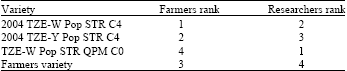
Selection or ranking of varieties were done on a scale of 1-4 for early maturing varieties and 1-5 for medium maturing varieties, 1 being very good and 4 or 5 being poor. In the early varieties, 2004 TZE-W Pop STR C4 was ranked highest (1) and selected by more farmers, followed by 2004 TZE-Y Pop STR C4 (2). The variety TZE-W Pop STR QPM C0 (4) was least selected by farmers (Table 7). However, the variety which was least selected by farmers (TZE-W Pop STR QPM C0) was ranked first (1) by researchers and the Farmers variety last (4).
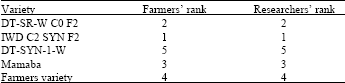
In the medium maturing varieties, IWD C2 SYN F2 was ranked highest (1) by both researchers and farmers, followed by DT-SR-W C0 F2 (2).
| Table 3: | Grain yield (kg ha-1), days to 50% anthesis (DFA) and days to 50% Silking (DFS) of four medium maturing drought tolerant maize and farmers’ varieties tested across three locations in the transition zone of ghana |
 | |
| Table 4: | Days to 50% silking (DFS), percent of plants lodged, plant density and grain yield (kg ha-1) of medium maturing maize baby trials planted in Kintampo and Techiman farming communities |
 | |
| Table 5: | Days to 50% anthesis (DFA), days to 50% silking (DFS), plant density and grain yield (kg ha-1) of medium maturing maize baby trials planted in Wenchi farming communities |
 | |
The variety DT-SYN-1-W was least (5) selected by both farmers and researchers and the Farmers variety (4) was last but one (Table 8). In this maturity group, farmers variety preferences were surprisingly in perfect agreement with those of the researchers.
The rainfall figures for Techiman during the crop growing period was 356.1 mm and was obtained over a very short period of 25 days which was inadequate for good crop growth and development (Table 9). However, rainfall figures and distribution for Kintampo and Wenchi of 515.0 mm (41 days) and 516.1 (40 days), respectively, were just enough for good maize growth and development (Table 9).
DISCUSSION
On-farm testing of promising crop varieties identified on-station is an essential stage in the development and eventual release of suitable varieties to farmers. Generally, farmers responded positively in the assessment of the new varieties they evaluated based on grain yield and other non-reproductive parameters. Most of the improved varieties had been appreciated by both researchers and farmers. In the early set mother trials, farmers rankings of varieties were quite different from those of researchers, however, in the medium set variety trials both actors ranked the varieties in the same order (Table 7, 8). Abebe et al. (2005) in a similar investigation observed that farmers preferences in some cases coincide with the breeders’ selection. The present investigation also confirms the observation by Bellon (2002) that farmers’ perception about crop varieties are not always the same as breeders and if given the opportunity, farmers are able to express their preferences differently. For instance, in the early set mother trials, the variety TZE-W Pop STR QPM C0 was ranked first (1) and Farmers’ variety last (4) based on grain yield by researchers (Table 7). However, TZE-W Pop STR QPM C0 was the least preferred (4) by farmers but 2004 TZE-W Pop STR C4 was their best choice (1). In the medium maturing varieties, IWD C2 SYN F2 was ranked highest by both researchers and farmers and the farmers variety was last but one.
| Table 6: | Assessment of selection criteria or parameters used by farmers in three farming communities on a ranking scale of 1-9 in order of importance |
 | |
| Scale: 1 = Most important, 9 = Least important | |
| Table 7: | Ranking of early varieties according to farmers and researchers impression on a scale of 1-4 in order of importance |
 | |
| Scale: 1: Very good, 4: Poor | |
| Table 8: | Ranking of medium varieties according to farmers’ and researchers’ impression on a scale of 1-5 in order of importance |
 | |
| Scale: 1: Very good, 5: Very poor | |
| Table 9: | Rainfall figures (mm) for the crop growing period for Techiman, Kintampo and Wenchi in 2009 |
 | |
| Source: Meteorological Services, Wenchi, Techiman and Kintampo, Ghana | |
The poor correlation between farmers and researchers ranking of the early maturing varieties in the mother trials bears testimony to the statement by De Groote et al. (2002). They stated that most scientists put a lot of controlled measures in their research methodology which are often not representative of farmers circumstances and the improvement of limited number of traits might not represent farmers preferences. Farmers were not included in the development of the variety TZE-W Pop STR QPM C0 and therefore did not know its inherent good traits and rated it very low. The adoption rate of such unknown varieties could have been low as indicated by Mekbib (2006) that if farmers are excluded in the development process they often reject new varieties that do not fulfil their multipurpose values. However, through this participatory varietal evaluation farmers realised that the attributes of drought and striga tolerance and the quality protein trait in TZE-W Pop STR QPM were advantageous for them. This scenario agrees with the observation by Nkongolo et al. (2008) that participatory varietal evaluation adds information on farmers perceptions of plant and grain traits and ensures that new varieties satisfy their preferences and suit their socio-economic situations.
The Farmers variety exhibited poor performance in both the mother and baby trials and in the ranking of varieties by farmers and researchers in both maturity groups. The regression coefficient of the grain yield of the most promising early TZE-W Pop STR QPM C0 and medium IWD C2 SYN F2 varieties on to the Farmers variety (Fig. 1, 2) of 0.78±0.204 and 0.82±0.242, respectively, is close to one indicating their increased response to improving environmental conditions (Virk and Witcombe, 2002). The rainfall figure (356.1) and distribution (40 days) for Techiman (Table 9) during the crop growing period fell short of the requirement of maize as stated by Taba and Twumasi-Afriyie (2008) and Department of Agriculture, Forestry and Fisheries (2008). However, the yield of the drought tolerant varieties in the drought prone environment was still higher than the Farmers variety. The new drought tolerant varieties, TZE-W Pop STR QPM C0 and IWD C2 SYN F2 were thus adaptable to the sample of target environments and therefore, were ideal replacement for the Farmers’ variety. Incidentally, some farmers without authorization kept some drought tolerant seed for planting in subsequent seasons. This development supports the findings of Mulatu and Belete (2001) that participatory varietal selection is a means of increasing genetic diversity and enhancing the rate of adoption through farmer to farmer seed exchange. The two most promising varieties, TZE-W Pop STR QPM C0 and IWD C2 SYN F2 were recommended by the Maize Breeding Programme at Crops Research Institute to the National Variety Release Committee (NVRC) for release to farmers in 2010. However, only TZE-W Pop STR QPM C0 was approved and released under the local name Omankwa meaning, it gives life. One of the reasons why this variety was accepted for release was because it is a Quality Protein Maize (QPM) which can improve malnutrition even though it was less preferred by farmers (Table 7). Both farmers and researchers had indicated their preference for IWD C2 SYN F2 (Table 8) and therefore it is advisable for the Maize Programme to re-submit this variety for re-consideration by the NVRC for release due to its other important attributes like drought and striga tolerance and high yield potential as manifested in this investigation.
CONCLUSION
Farmers may require multiple traits from one key crop such as maize. However, plant breeders may not know the traits that are important to farmers and vice versa. Apart from the drought tolerance of the released variety TZE-W Pop STR QPM C0 it has other important traits of quality protein and striga resistance which farmers did not know and therefore ranked it very low in preference. Multiple traits have to be considered for successful dissemination of improved varieties. The importance and complex nature of agricultural research demands coordinated effort among all actors in order to ensure that appropriate technology is developed and promoted. The collaboration between biological scientists, extension agents and farmers show promise for improving the selection procedure if farmers are informed early in the breeding process.
ACKNOWLEDGMENT
We are grateful to IITA-CRI-DTMA Project for providing funds for this study. Our special thanks also go to Techiman, Wenchi and Kintampo farmers who participated in the on-farm evaluation of the varieties. We also thank technicians of the Maize Breeding Programme and the On-Farm unit at CRI for packaging and supervising the conduct of the trials.
REFERENCES
- Abebe, G., T. Assefa, H. Harrun, T. Mesfine and A.R.M. Al-Tawaha, 2005. Participatory selection of drought tolerant maize varieties using mother and baby methodology: A case study in the semi arid zones of the Central Rift Valley of Ethiopia. World J. Agric. Sci., 1: 22-27.
Direct Link - Nkongolo, K.K., K.K.L. Chinthu, M. Malusi and Z. Vokhiwa, 2008. Participatory variety selection and characterization of sorghum (Sorghum bicolor (L.) Moench) elite accessions from Malawian gene pool using farmer and breeder knowledge. Afr. J. Agric. Res., 3: 273-283.
Direct Link - Mekbib, F., 2006. Farmer and formal breeding of sorghum (Sorghum bicolor (L.) Moench) and the implications for integrated plant breeding. Euphytica, 152: 163-176.
CrossRef - Mulatu, E. and K. Belete, 2001. Participatory varietal selection in lowland sorghum in Eastern Ethiopia: Impact on adoption and genetic diversity. Exp. Agric., 37: 211-229.
CrossRef - Rao, N.H., J.C. Katyal and M.N. Reddy, 2004. Embedding the sustainability perspective intoagricultural research: Implications for research management. Outlook Agric., 33: 167-176.
Direct Link