

Sule Turhan
Department of Agricultural Economics, Faculty of Agriculture, University of Uludag, Gorukle-Bursa, 16059, Turkey
Basak Canan Ozbag
Department of Agricultural Economics, Faculty of Agriculture, University of Uludag, Gorukle-Bursa, 16059, Turkey
Bahattin Cetin
Department of Agricultural Economics, Faculty of Agriculture, University of Uludag, Gorukle-Bursa, 16059, Turkey
Journal of Applied Sciences
Year: 2007 | Volume: 7 | Issue: 13 | Page No.: 1734-1740







ABSTRACT
The main aim of this study is to examine the determinants of location choices for food processing plants using the results of 59 personal surveys. The 61.3% of the food processing plants that were interviewed are small scale plants, 9.1% are large scale plants and 29.6% are medium scale plants. Sixteen of the firms process vegetables, 12 process poultry, 12 process dairy and 9 process seafood products. Business climate factors are divided into six categories (market, infrastructure, raw material, labor, personal and environmental) and 17 specific location factors are considered. The survey responses are analyzed by types of raw materials processed and by plant size. 43.7, 55.3 and 42.2% of the respondents cited categories of Market, Raw Material and Infrastructure respectively as important, while 44.3, 50.7 and 74.4% of the respondents cited, labor, personal and environmental regulation categories of as not important. Thus survey findings indicate that plant location choices are mainly driven by market, raw material and infra structural factors. Environmental factors such as environmental regulations and permissions are relatively insignificant.
PDF Abstract XML References Citation
How to cite this article
Sule Turhan, Basak Canan Ozbag and Bahattin Cetin, 2007. Factors Affecting Location Decisions of Food Processing Plants. Journal of Applied Sciences, 7: 1734-1740.
DOI: 10.3923/jas.2007.1734.1740
URL: https://scialert.net/abstract/?doi=jas.2007.1734.1740
DOI: 10.3923/jas.2007.1734.1740
URL: https://scialert.net/abstract/?doi=jas.2007.1734.1740
INTRODUCTION
Food processing is an important sector in the South Marmara Region, where this study was conducted. As a matter of fact, 44.7% of fruit-vegetable processing industry, 22.4% of poultry industry, 26.4% of dairy industry and 33.2% of seafood industry takes place in the South Marmara Region. An important part of the firms operates both for local market and foreign market (Çetin, 1999). In general, for other industries, several surveys and analyzes have been conducted to determine why firms are located where they are (Bartik, 1985; Austin, 1992). Other studies use optimization models to prescribe plant-level location choices based on transportation costs, plant cost conditions and local prices etc. Such models distinguish essentially between three general types of plant location: a first plant or a relocation by a firm; a branch plant location due to the development of a distant market and a branch plant location selected after several new alternative markets have been considered, where at least one of the alternative markets has grown to significant size (Greenhut, 1960). For the food processing plants, previous studies assessed the determinants of location choices: Lopez and Henderson (1989) examine the determinants of location choices for new food processing plants in five U.S.A. states using a telephone survey in their study; Madariaga and Bertrand (2002) attempt to evaluate the impact of macroeconomic location factors on US outward foreign direct investment in Argentina, Brazil, Canada and Mexico over the period 1989-1998. They perform econometric analysis in order to separate economic integration from other parameters influencing foreign direct investment location.
Firms make strategic choices about location factors as well as their ownership advantages (Campa and Guillen, 1999). Where to locate the food processing plant is a critical decision in managerial economics. In general, the first consideration is where the food processing plant should be, in relevance with its agricultural and non agricultural raw material suppliers and factors that are taken into market, transportation is an essential component of this decision (Karayalcin, 1972; Cetin, 1999). Other considerations are labor supply, the availability of infrastructure, environmental regulations and developmental effect.
The food processing plant must decide whether to locate close to the agricultural raw material or close to the market for finished goods. Naturally, the decision depends on the characteristics of the agricultural raw material and its transformative process, as well as on the costs and availability of transportation services.
MATERIALS AND METHODS
Personal questionnaires were used to collect information on factors affecting the location decisions of food processing plants established within the last 15 years in three cities (here in referred to as South Marmara Region): Bursa, Balikesir, Çanakkale. Personal interview method was used in order to collect reliable data from a representative sample of South Marmara Regions' food processing plants. The target sample of firms includes five types of raw agricultural material: vegetables, fruits, poultry, milk and seafood. These types of raw agricultural material were targeted because of their increasing shares in this sector in Turkey.
A preliminary survey was developed which was pretested with five food processors, a policy maker, two food industry experts and a social scientist. Further changes were made until the final draft was pretested with a vegetable, milk and a seafood expert, with the feedback that no further changes were necessary. The survey development and implementation followed the steps suggested by Dillman (1978), Austin (1992) and Leistritz (1992).
Three different types of questions were included in the questionnaire; characteristics of the food processing plants, general business climate categories, 17 specific location factors.
The general business climate categories mentioned are market, infrastructure, raw material, labor, personal and environmental rules or regulation. The food processing plants built after 1985 (1985-2002) were targeted as the sample. Type of raw agricultural materials processed across firms shaped the sample design.
The respondents were asked to evaluate each of the firms’ categories on a four-point Likert Scale ranging between 4 = very important, 3 = important, 2 = not important and 1 = don't know, presenting the importance of each of the 17 specific locational factors. After each specific factor had been mentioned, the respondents were asked to evaluate how important the overall category was containing the specific factors. Almost all (96.1%) of the respondents were either a corporate executive, or a proprietor, a plant manager for their firm who were supposed to be informed enough for the purpose of the survey.
This study was based on two main characteristics of the firms, which are the type of raw agricultural material processed and the plant size.
Of the 59 personal interviews completed in the summer of 2002, the majority (61.3%) of the food processing plants interviewed are small scale plants (less than 25 employees), 9.1% are large scale plants (more than 100 employees) and 29.6% are medium scale plants (25-99 employees). In terms of raw agricultural material, 16 (27.1%) involved plants processing vegetable products, 12 (20.3%) fruits, 10 (16.9%) poultry, 12 (20.3%) dairy and 9 (15.3%) seafood products.
RESULTS AND DISCUSSION
Location survey results are presented in Tables 1-4. The surveys are analyzed both for the entire sample, and for two main characteristics; Type of raw agricultural materials processed (fruit, vegetables, poultry, milk and seafood), Plant size (number of employees).
The survey responses were ranked according to the frequency of very important answers. In addition, considering the frequency of -important- answers broke ties. The results obtained from the plants, which were investigated in terms of six agribusiness environmental factors, have been examined under basic titles.
Market: Consideration of the marketing factor is vital to management analysis of the Agri-food industry, because it provides the market information to assess an agri-food plant’s viability (Cetin et al., 2000). Since agri-food plants enter existing markets, it is essential that firms know the market conditions (Austin, 1992). Thus, firms should analyze the market structure, consumer behavior and the basis of competition within where the plant is located.
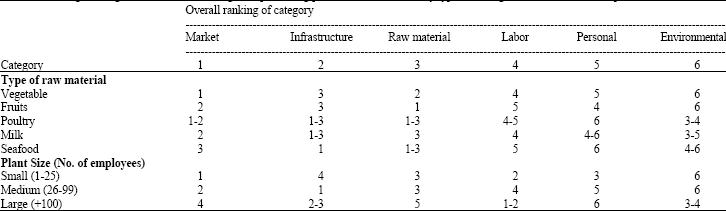
The survey findings indicate that the market-related category was the most frequently cited (35.6% of the sample) as-very important- in the decision as to which city to be located in (Table 1). While market, raw material and infrastructure categories affect the location decisions with a similar weight, firms show less sensibility to environmental category. On the other hand, Table 2 shows the ranking of market category by type of processed raw material and by plant size.
According to the survey results, proximity to the market and proximity to distribution centers were the most frequently cited market factors as being-very important (Table 3).
In terms of all 17 specific locational factors, these factors ranked second and seventh, respectively. Therefore, the survey results provide strong evidence that location decisions in the South Marmara Region are strongly affected by market factors.
The technological factors that were changing in the broiler industry in the 1950s and 1960s included mechanical and engineering advances in broiler chick housing, materials handling and processing, and adaptable organizational technology such as contract and vertical integration (Abdalla et al., 1995).
| Table 1: | Importance and ranking of categories of factors affecting food industry plant location decisions |
 | |
| Note: Ranking is based on frequency of very important responses, Ties are broken by using frequency of important responses. Total number of responses is 59 | |
| Table 2: | Ranking of categories of factors affecting food processing plant location decisions by type of raw agricultural materials and plant size |
 | |
| Table 3: | Importance and ranking of specific location factors |
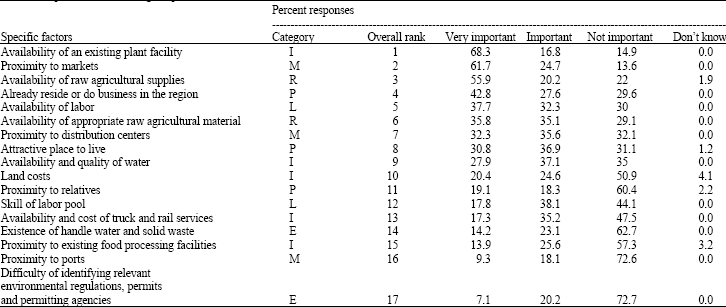 | |
| Note: Categories are defined as M = Market, I = infrastructure, L = Labor, R = Raw material, P = Personal and E = Environmental regulation. These categories ranking is based on the descending frequency of “very important” responses and ties are broken (whenever possible) based on the frequency of important responses. Total number of responses is 59 | |
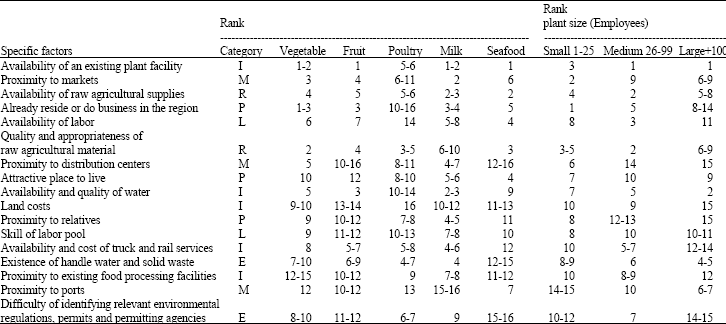
This is a general and understandable result. Since poultry processing plants mostly integrate vertically when they locate or establish production contracts (as contract farming) with poultry farmers, so that pre-existence of raw material supply for the processing becomes relatively less important. Except for poultry plants, proximity to markets was ranked in the top six (out of 17) factors driving location decisions. Proximity to distribution centers was ranked variously by product type in the top 10 for vegetable, milk and poultry processors. Naturally, proximity to a port was ranked as eight by seafood processing plants (Table 4).
In terms of plant size, measured by the number of employees, the survey findings indicate that the market criterion is the most important for the location of small processing plants (Table 2). Besides, the importance of the market criterion is negatively correlated with size.
| Table 4: | Ranking of specific location factors by types of raw materials and plant size |
 | |
Proximity to markets, distribution centers and availability/cost of truck and rail services seem to be more critical to the location of small plants than to the location of larger ones.
Effect of proximity to ports and difficulty of environmental regulations does not seem to be correlated with the size of the new plants, since the factor ranking was between 7-15 (out of 17) across sizes. It can be said that this factor was the least important factor across plant size affecting location decisions of food processors in the study area.
Infrastructure: Since insufficient infrastructure can increase costs and reduce quality, the agro industrial plant should consider the facilities and services available at alternative locations. Experts in this field have recommended that a plant should examine a location for the basic infra structural aspects such as water, electricity, existing food processing facilities etc.
In addition, the firm should also assess the transport infrastructure, including roads, availability and cost of truck and rail services and storage terminals. The firm should also consider the social infrastructure including housing, schools and health and recreational facilities because these components may affect the plant’s ability to recruit the necessary personnel.
According to the survey findings the infrastructure category was the second most frequently cited (out of six) criteria in choosing a city in which to locate (Table 1). However, when ranking is based on the combined frequency of -important- and -very important-responses, infra structural factors are ranked as the first because of the high proportion of responses under the -important- category (55.3%). Only 17.5% of the respondents indicated that infra structural factors were unimportant in their location decisions, the lowest proportion across all six categories.
The majority of respondents (68.3%) considered availability of an existing plant as the most important factor across all 17 specific factors (Table 3). This question did not mention anything about the possibility of the plant site being either supplied by the private sector (e.g., previously owned plant) or by the local government (e.g., state-sponsored industrial zones). Availability and quality of water and land costs were ranked as the second and third within the infrastructure category. It should be noted, however, availability and quality of water is also related with the environmental issues. One of the traditional business climate factors, land costs, was ranked as the 10th and thus, played a secondary role in plant location decisions (Table 3).
On the other hand, with respect to types of raw agricultural materials processed, the survey results indicate that the infrastructure criteria is the most important category for seafood and more important for poultry and milk processors (Table 2). The infrastructure category was ranked in the top three (out of six) for poultry and milk processor while it was ranked as the third for vegetable and fruit processing plants. Thus, according to the determination of survey findings infra structural factors as a whole appear to be less important in influencing the location decisions of vegetable and fruit processors relative to other types of plants.
Availability of an existing plant facility is the most important factor in influencing the processing plant location decisions for all product types, except for poultry processing plants where it was ranked as the fifth or sixth out of 17 factors (Table 4). Availability and quality of water was ranked in the top 10 range but appears to be more important at affecting the location of milk and fruit processing plants where it was ranked second and third, respectively.
With respect to size of plant, the survey results indicate that the infrastructure category is quite important across plant sizes (Table 2). However, larger plants generally have given more importance to infra structural factors than smaller ones. On the other hand, land cost was ranked in the top ten for small and medium size plants but more relatively unimportant (15th) for large plants.
Agricultural raw material: Before an agro-industrial firm is located and investments are made for a processing plant, procurement of raw agricultural material inputs must be studied as carefully as the marketing activities. Agro industries transform inputs; if those inputs are defective, processing and marketing will suffer accordingly. In short, a well-organized procurement system is able to supply enough raw material with acceptable quality at the appropriate time and at a reasonable cost (Cetin, 1993).
Availability of raw agricultural material supplies and availability of appropriate raw agricultural material supplies were quite important across all sizes of plants (Table 4).
The survey results indicate that the agricultural raw material criterion was frequently cited (42.2% of the sample) as -important- in the decision of which city to be located in (Table 1). With respect to types of raw agricultural materials processed, the survey findings indicate that the agricultural raw material criterion is the single most important criteria for fruit and relatively less important factor for vegetable poultry and seafood processors (Table 2).
In terms of size of the plant, the survey results indicate that the raw material criteria is important for the location by small and medium sized processing plants.
According to the survey results, availability of raw agricultural material supplies, availability of appropriate raw agricultural material were the most frequently cited raw material factors as being -very important- (Table 3). In fact, in terms of all 17 specific locational factors, these factors were ranked as the third and sixth, respectively. While the mentioned factor was more important during the previous years, as a result of the application of contract farming it became less important (Cetin, 2000).
Availability of raw agricultural supply is most critical for milk and seafood processing plants (Table 4). With respect to types of raw agricultural material supplies processed, availability of raw agricultural material supplies was the top-ranked market factor across plants. According to the survey findings, it was ranked as the highest for seafood plants (second out of 17 factors), poultry plants was ranked as the lowest (5-6th out of 17) across the five product (vegetable, fruit, poultry, milk and seafood) types (Table 4).
On the other hand, appropriateness of raw agricultural material is most critical for vegetable processing plants. For milk processing plants while availability of raw agricultural supplies is the 2nd and 3rd important factor, the ranking of appropriateness of raw agricultural material varies between 6 and 10. The difference between the ranking of availability of raw agricultural supplies and appropriateness of raw agricultural material can be explained by quantitative characteristics of milk; i.e., milk has to be standardized before the process because of its structural characteristics. Thus appropriateness of raw agricultural material is less important than availability of raw agricultural supplies for milk processing plants.
Labor: Since agro-industries seldom directly employ many workers, they usually are not sensitive to the supply of unskilled labor. In general, skilled labor and managerial talent is more difficult to find, a constraint especially acute if the plant is in a rural area (Austin, 1992; Connor et al., 1985).
The survey results indicate that food processors in the South Marmara Region consider labor factors as their fourth most important (out of six) category in choosing a city in which to locate (Table 1). It can be seen from Table 1 that a total of 56% of respondents indicated that labor (especially qualified) was -important and very important- in location decisions. Within the labor category, availability of labor was ranked as the most frequently cited factor (37.7% of responses) as being-very important- in influencing location decisions (Table 3). An important point is that food processors in the region are less concerned with the labor cost, wage rate etc. when choosing a city or region in which to locate.
With respect to types of agricultural raw materials processed, availability of labor was most critical to the location of seafood processing plants when it ranked fourth out of 17 (Table 4). Besides availability of labor was ranked in the top eight for the remaining types of processors, except for poultry while it was ranked as the 14th. Thus, availability of labor does not seem to be a relatively important factor for the decision of poultry plants. On the other hand, with respect to the size of plant, the survey findings indicate a weak correlation between the importance of the labor factors and plant size, except for the medium size plants (Table 4).
Personal factors: The survey findings show that the personal criterion was the fifth (out of six) most frequently cited as -very important- when choosing a city in which to locate (Table 1). A total of 48.1% of respondents stated that personal factors were -important or very important- in locating their plant.
Within the personal factors category, the majority of respondents (42.8%) considered the fact that already residing or doing business in the city as the most important factor in locating their plants (Table 3). This was followed by the attractiveness of the place for living (30.8%) and proximity to relatives (19.1%).
With respect to product types, it is evident that already residing or doing business in the region or city are more important for the location of nonpoultry plants (ranked consistently in the top five out of 17) (Table 4). On the other hand, with respect to the size of the plant (number of employees), the survey findings indicate that the personal factor criterion is quite more important for the location decisions of small plants than large ones (Table 2).
Environmental factors: Environmental factors were found to be less important compared to other factors affecting location decisions in many less developed and developing countries (Campa and Guillen, 1999). Thus, it was observed in the research area that firms give less importance to environmental factors compared to other factors and firms tend to follow the legal environmental law (regulations etc.) within the minimum level possible. The environmental factor was the least frequently cited (out of six categories) as -very important- in choosing a city or region to locate in (Table 1). Less than 10.5% of the respondents indicate that environmental factors were very important in driving their location decisions.
A total of 24.8% of respondents reported that environmental factors were -important and very important- in locating their plant.
Within the environmental factor category, existence of handle water and solid waste was the most frequently (14.2% responses) cited factor as being very important for the location decisions (Table 3). This factor was followed by environmental regulations and permits (7.2 %).
With respect to types of products processed, the survey results indicate that the environmental factor category is relatively important for poultry plants only, where it was ranked in the top for (out of six) (Table 2). For nonpoultry processors, environmental factors were generally important but not in the top 6. It can be seen from Table 2 that with respect to plant size, environmental criteria is the most important factor (out of six) driving the location of large plants.
CONCLUSIONS
In this study the determinants of location choices for food processing plants in the South Marmara Region have been examined using the results of personal surveys. The factors and the reasons behind, which were taken into consideration by the agri-food firms in terms of location decisions, can be as follows according to the results obtained from the study.
Firms take into consideration the market location and the availability of raw material with the highest priority. This situation varies depending on the capacities of the firms; as the scale goes up, the importance of these factors goes down relatively. The results show that categories of market and raw material are the leading factors in the location decisions of vegetable and fruit processing firms and poultry industry.
Another factor that has importance in the location decisions of agri-food firms is the infrastructure possibilities. The fact that especially seafood, dairy and poultry firms are more selective is one of the results obtained from the study. As the scale of the firm increases, they tend to behave more selective in terms of infrastructure. When we look at the importance and ranking of specific location factors, we conclude from the survey results that proximity to markets, availability of n existing plant facility, availability of raw agricultural supplies have been ranked as very important with the following percentages respectively; 61.7, 68.3 and 55.9.
The fact that the convenience (tax discount, investment opportunities etc.) offered by the state in terms of setting out the infra structural circumstances affects the location decisions especially in terms of having quality raw material.
It is determined that contract farming, which has increased during recent years, is another important factor affecting the location decisions especially in terms of having quality raw material.
However, these factors which are mentioned above are important for the location of all types of food plants, especially for the location of poultry, fruit and seafood plants. It can be stated that, required information should be provided in a timely manner for the establishment of a new food processing plant. If mentioned information is used, by agri-food processors and manufacturers, then the location decisions would usually take a short time such as less than 4-6 months. Although the availability of required information is easy, the fact that the decision of the location choices is affected by all the internal and external resources, constraints and objectives should not be excluded in the analysis.
REFERENCES
- Campa, J.M. and M.F. Guillen, 1999. The internalization of exports: Firm and location specific factors in a middle income country. Manage. Sci., 45: 1463-1478.
Direct Link - Leistritz, F.L., 1992. Agribusiness firms: Location determinants and economic contribution. Agribusiness, 8: 273-286.
Direct Link