

M. Zulfakar
School of Bioprocess Engineering, Universiti Malaysia Perlis, Kompleks Pusat Pengajian Jejawi 3 02600 Jejawi, Perlis, Malaysia
N. A. H. Hairul
School of Bioprocess Engineering, Universiti Malaysia Perlis, Kompleks Pusat Pengajian Jejawi 3 02600 Jejawi, Perlis, Malaysia
H. M. R. Akmal
School of Bioprocess Engineering, Universiti Malaysia Perlis, Kompleks Pusat Pengajian Jejawi 3 02600 Jejawi, Perlis, Malaysia
M. Abdul Rahman
School of Chemical Engineering, Engineering Campus, Universiti Sains Malaysia, 14300 Nibong Tebal, Penang, Malaysia
Journal of Applied Sciences
Year: 2011 | Volume: 11 | Issue: 13 | Page No.: 2320-2326







ABSTRACT
Remediation of hazardous materials in water has emerged as a top priority over the years. Organic pollutants in water are one of the major constituents in water pollution. Phenol is one of the organic pollutants which are commonly found in the effluent of industries such as petroleum refineries and petrochemicals. Conventional treatment techniques such as filtration and flocculation and carbon adsorption have limitations of their own. Thus, photocatalysis offers a possible alternative in treating wastewater effluent containing phenols. This study attempts to evaluate photocatalytic degradation of phenol in a fluidized bed reactor. Immobilized TiO2 supported onto quartz sand was used as the photocatalyst and characterized using SEM, EDX and XRD analysis. The performance of the supported photocatalyst is evaluated in different operating parameters such as photocatalyst loading and initial phenol concentration.
PDF Abstract XML References Citation
Received: February 15, 2011;
Accepted: February 19, 2011;
Published: May 28, 2011
How to cite this article
M. Zulfakar, N. A. H. Hairul, H. M. R. Akmal and M. Abdul Rahman, 2011. Photocatalytic Degradation of Phenol in a Fluidized Bed Reactor Utilizing Immobilized TiO2 Photocatalyst: Characterization and Process Studies. Journal of Applied Sciences, 11: 2320-2326.
DOI: 10.3923/jas.2011.2320.2326
URL: https://scialert.net/abstract/?doi=jas.2011.2320.2326
DOI: 10.3923/jas.2011.2320.2326
URL: https://scialert.net/abstract/?doi=jas.2011.2320.2326
INTRODUCTION
Since the beginning of industrialization, the variety and quantity of pollutants emitted into the environment has steadily increased. Most advanced industrialized nations in the world are faced with a tremendous set of environmental problems related to the control of toxic air contaminants and the remediation of hazardous wastes and contaminated groundwater’s. The environment was contaminated and is being contaminated by mistake due to human being’s ignorance in the past, now and in the future. One of the key concerns is the protection and remediation of the world’s finite potable water supply. Remediation of the hazardous materials in the water has emerged as a top priority over the years. Organic pollutants in water are one of the major constituents in water pollution. These organic pollutants include phenolic compounds, dye stuff consisting complicated aromatic rings, petroleum products such as oil and gasoline, pesticide, solvent, cleaning agents and polychlorinated biphenyls (PCB). Phenol tops the list of the organic pollutants which is commonly found in the effluent of coal conversion process, coke ovens, petroleum refineries, phenolic resin manufacturing, herbicide manufacturing, fiberglass manufacturing and petrochemicals (Veeresh et al., 2005). The presence of phenols in wastewater is potentially toxic to human, aquatic and microorganism life. Aquatic life is in the imminent danger of extinction if phenol containing wastewater is left untreated. Apart from that, phenol exposure can adversely affect our health as it is poisonous and highly corrosive to the skin and readily absorbed through it. Ultimately, the central nervous system would be affected and cause irreversible damage to the liver and kidneys. Therefore, it is the utmost importance to destroy phenol from the wastewater effluent to protect Mother Nature and the well being of human life. Hence, the water effluent should be treated to an acceptable level of phenolic amount that is less than 1 mg L-1, enacted by the Department of Environment (DOE) in Environmental Quality Act 1974 (Sewage and Industrial Effluent).
TiO2 heterogeneous photocatalysis has been the subject of numerous investigations in recent years as it is an attractive technique for the complete destruction of undesirable contaminants in both liquid and gaseous phase by using artificial light or solar illumination (Toyoda et al., 2000). TiO2/Sn2 has the potential for using as a catalyst on degradation of phenolic contaminated water (Khuanmar et al., 2007). Titania photocatalysis advantages of low operation temperature, low cost, significantly low energy consumption have led the relevant application to the stage of commercialization. However, most of commercially available TiO2 suffers from its nanosized particle dimensions that require a difficult catalyst-recovery stage which in turn significantly decreases the overall efficiency of the process (Haque et al., 2005). Hence, much effort has been centered on developing supported titania catalysts that can offer high efficiency combined with better recovery properties.
Despite the effectiveness of the heterogeneous photocatalytic processes, the operating cost for the total mineralization of hazardous organic effluents remains high. The reasons were due to the drawbacks found in the conventional TiO2 slurries system which limit its practical applications (Pozzo et al., 1999). The use of TiO2 slurries system limits practical applications because of problems of separation of fine particles of TiO2 and the recycling of photocatalyst. The micrometric size of particles makes it difficult to be separated from water after use (Alnaizy and Akgerman, 2000). To make matters worse, these fine solid particles from the effluent may cause turbidity in the downstream and therefore can actually decrease the depth of UV penetration. This in turn will drastically lower the photocatalytic reaction. Thus, many techniques were proposed for the immobilization of TiO2 on solid supports to eliminate this problem.
Fluidized bed photocatalytic reactor systems have several advantages over conventional immobilized or slurry-type photocatalytic reactors. The unique reactor configuration provides both exposure of photocatalyst to UV light and good penetration of the light into the photocatalyst bed that allow more contact of photocatalyst and reactant fluid. Also, UV light can be more evenly distributed within the given catalyst bed (Lim and Kim, 2004).
This study was aimed to elucidate the effect of different process parameters in the photocatalytic degradation of phenol in a fluidized bed reactor. Effect of initial catalyst loading and initial phenol concentration will be investigated. The photocatalyst used will also be characterized by means of SEM, EDX and XRD analysis.
MATERIALS AND METHODS
Materials and chemicals: Quartz sand (Aldrich quartz white sand, Cat. No. 27473-9; r = 2.4 g cm-3; particle size: +50/-70 mesh) was used as the support material throughout the experiment. Quartz sand was washed with acetone (Fisher Scientific) prior to being used to remove organic matters. Phenol (Merck, 99.5%) was used as model pollutant. All solutions were prepared using deionized water from Milli-Q system and controlled by its resistivity (18 MΩ).
Commercial extra pure titanium isopropoxide (TTIP) (Aldrich), isopropanol (Fisher Scientific), diethanolamine (DEA) (Fisher Scientific) and nanophase TiO2 Degussa P-25 powder (50 m2 g-1; 15-30% rutile + 85-70% anatase, mean diameter 50 nm) were used for the preparation of the sol.
Preparation of sol-gel solution: A 0.5 M solution of TTIP in isopropanol was prepared and subsequently a suitable amount of DEA was added to the solution. A molar ratio of DEA/TTIP = 4 was used. The solution was stirred at room temperature for 2 h. Subsequently water was added drop by drop under vigorous stirring. A molar ratio of H2O/TTIP = 2 was used. A clear sol was obtained. The sol was sealed and left for aging for at least one day before being used. It was observed that after storage for many months, the sol was remarkably unchanged. This sol was also stable at room temperature.
The modified sol-gel was prepared by addition of a calculated amount of TiO2 Degussa P-25 to the sol solution. The powder was added slowly with vigorous stirring to prevent the formation of agglomerates. A thick, white, viscous solution was obtained. This solution settled slowly over a period of two weeks. To prevent settling, the modified sol was stirred constantly while in storage between experiments.
TiO2 immobilization onto support: An amount of 1 g quartz sand: 1 mL of sol ratio was used for the immobilization process. The support and TiO2 sol were mixed in a rotary evaporator by rotating it for 1 h without applying heat. Subsequently, the mixture was evaporated until complete dryness under vacuum controlled condition. The coated support was further dried in the oven at 120°C for 2 h and then subjected to heat treatment in the furnace. The furnace temperature was increased at a ramp rate of 3°C min-1 until it reached 100°C and was held for 1 h. Next, the temperature was increased at a ramp rate of 3°C min-1 up to 600°C and held for 1 h. Finally, the furnace was cooled down to room temperature at a ramp rate of 3°C min-1. The support was weighted again to calculate the amount of TiO2 film attached on it.
Experimental set-up: The experimental rig consisted of a quartz glass column as the main chamber for the photocatalytic reaction with an air distributor with mesh size of 200 micron to provide uniform fluidization of the photocatalyst. A UV lamp enclosure with four 20W UV lamps with wavelength of 254 nm were used as UV source surrounding the quartz glass column. Air compressor was used to provide air for fluidization throughout the experiment. The experimental rig is depicted in Fig. 1.
All reaction was carried out at atmospheric pressure and at temperature of 30°C. The UV lamps were turned on after 30 min of dark reaction to ensure that adsorption equilibrium is achieved.
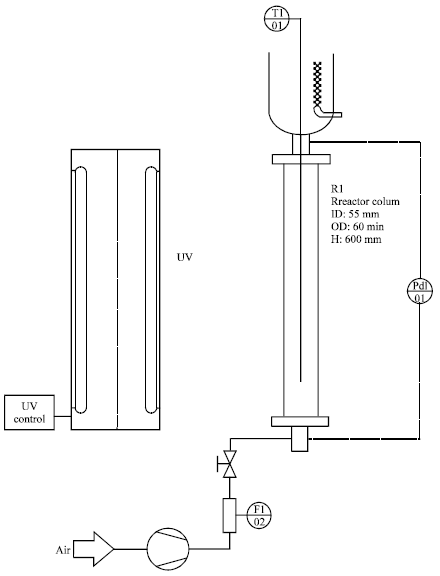 | |
| Fig. 1: | Fluidized bed reactor rig set-up |
Phenol concentration at this point was used as the initial value for further kinetic investigation of the degradation process. Samples were withdrawn every one h. The analysis was done using High Performance Liquid Chromatography (HPLC) (Perkin Elmer).
RESULTS AND DISCUSSION
Characterization of TiO2 thin films: A number of analytical techniques were used to study the characteristics of the immobilized TiO2. The analytical techniques employed were applied to obtain information about possible transformations in their characteristics and to determine which characteristics affect the photocatalyst performance. Three analytical methods were utilized in the photocatalyst characterization:
| • | Scanning electron microscopy |
| • | Energy dispersive X-ray spectroscopy |
| • | X-ray diffraction |
Scanning electron microscopy: Scanning Electron Microscopy (SEM) was used to study structure and morphology of the TiO2 films immobilized on quartz sand and silica gel. The resulting images obtained are depicted in Fig. 2. TiO2 films can be clearly seen covering the surface of the quartz sand. Figure 2 show the shape of quartz sand and silica gel. It can be said that the quartz sand have roughly the same shape and have rough and non-uniform surface. Existence of microcracks (as highlighted in the images) is obvious in the surfaces of quartz sand owing to these rough and non-uniform surfaces. It is believed that these microcracks exist due to the method of preparation. When the supports are mixed with the sol gel in the rotavapor, it is very hard to control the amount of sol attached to the support in order to obtain even thickness.
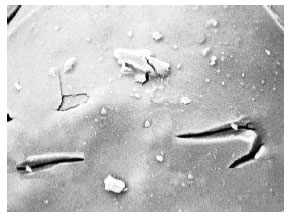 | |
| Fig. 2: | Scanning electron micrographs of TiO2 thin film immobilized on quartz sand. Conditions: calcinations temperature = 600°C. Magnification of 1500 X |
When the film is too thick, it would contribute to the existence of cracks. The thick films tend to fracture and the possibility of microcracking occurring is high. The reason being is that the film begins to develop stresses when it is going with different stages of drying, crystallization and densification processes. These stresses are caused by chemical reactions during drying, difference in thermal expansion coefficients between supports and the TiO2 film, grain interaction and grain size of the TiO2 film (Balasubramanian et al., 2003).
The same observation was found by Balasubramanian et al. (2003, 2004). They observed microcrackings on the surface of the TiO2 thin films. However, they noted that these macrocrackings did not affect the performance of their photocatalytic degradation of 4-chlorobenzoic acid. This is in accordance with the present study, whereby the microcrackings observed did not contribute to the inefficiencies of the photocatalytic activity (Balasubramanian et al., 2003, 2004).
Energy dispersive X-Ray: Energy Dispersive X-Ray (EDX) is a chemical microanalysis technique in conjunction with scanning electron microscopy (SEM) chamber. EDX analysis was used to characterize the elemental composition of the photocatalyst thin films on the supports.
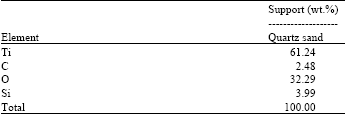
Figure 3 illustrate a typical EDX spectrum of the TiO2 thin films immobilized on quartz sand and silica gel. The elemental composition of the film immobilized on quartz sand and silica gel were found as 61.24 Ti, 2.48 C, 32.29 O, 3.99% Si and 53.26 Ti, 2.63 C, 31.77 O, 12.34% Si, respectively and is given in Table 1. The analysis confirmed the presence of titanium dioxide in the thin films.
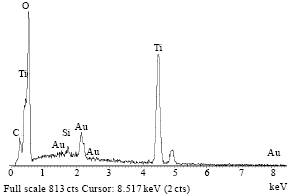 | |
| Fig. 3: | EDX spectrum of TiO2 films immobilized on quartz sand |
| Table 1: | EDX analysis |
 | |
X-ray diffraction: X-Ray Diffraction (XRD) was used to determine the crystallinity of the TiO2 films immobilized on quartz sand and silica gel. Figure 4 illustrates the XRD patterns of the TiO2 films immobilized on quartz sand. TiO2 immobilized on quartz sand were calcined at 600°C. From the figure, it can be observed that the anatase and rutile peaks appeared on the quartz sand. However, the major phase present on the films was anatase, while the presence of rutile phase was small. Anatase was reported as the desired crystalline phase in treating organic pollutants present in water as it shows the highest photocatalytic activity compared with rutile (Balasubramanian et al., 2004; Fujishima et al., 2000; Shephard et al., 2002; Qiu and Zheng, 2007).
Effect of catalyst loading: Since the photocatalytic reactions is governed by photon efficiency and mass transfer limitation, the reaction mechanism is believed quite different with conventional heterogeneous catalytic reaction (Nam et al., 2002). For a slurry reactor and photocatalytic immobilized reactor, the loading of the catalyst is a vitally important parameter that affects the rate of photocatalytic degradation (Parra et al., 2002). In a photocatalytic reactor, when the photocatalyst loading in the reactor is high, the excess photocatalyst particle will block an even penetration of UV light and thus reduce the effective UV light radiation that reaches the photocatalyst surface. Therefore, an optimum catalyst loading is necessary to avoid excess usage of photocatalyst in every system and to ensure optimum photon absorption.
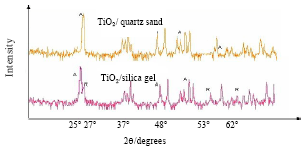 | |
| Fig. 4: | XRD patterns of TiO2 film immobilized on quartz sand. A: Anatase R: Rutile at 600°C |
Furthermore, in an economic point of view excess of photocatalyst should be avoided so that the cost would remain as low as possible.
To study the effect of initial catalyst loading in the photocatalytic degradation of phenol, an initial phenol concentration of 50 mg L-1 is chosen for every reaction while the initial catalyst loading is varied i.e., 0.16, 0.25, 0.33, 0.41 and 0.55 g L-1 (g TiO2 L-1 solution), respectively. The amount of TiO2 immobilized on quartz sand support is calculated by subtracting the weight of TiO2 coated support with the uncoated support. Collected data are analyzed and graphs are plotted. The phenol degradation versus time graph at different catalyst loading is shown in Fig. 5.
The results show that degradation of phenol increases with the increase of initial catalyst loading from 0.16 to 0.33 g L-1. However, the trend reverses when the amount of catalyst loaded is beyond 0.33 g L-1. An increase of catalyst amount over 0.33 g L-1 decreases the degradation of phenol over time.
The phenomenon can be explained as follows. As the dosage of the photocatalyst increased, the number of photon absorption increased but above certain level of the photocatalyst dosage, the hindrance and blocking of UV light penetration occurred in the reactor by excessive amount of the photocatalyst (Na et al., 2004).
Effect of initial concentration: In this study, photocatalytic degradation of phenol was performed in a fluidized bed reactor. Phenol concentration was varied between 25 to 200 mg L-1. Figure 6 shows the normalized concentration of phenol for various initial concentrations using TiO2 immobilized on two different supports; quartz sand and silica gel. The concentration of phenol decreases with the reaction time. From the figure, it is observed that the degradation of phenol shows identical trend for all the supports where an increase in initial concentration resulted in a decrease of degradation rate.
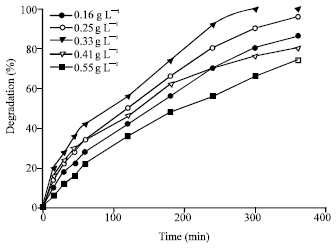 | |
| Fig. 5: | Degradation of phenol at different initial catalyst loading for quartz sand support |
It is obvious that the photocatalytic degradation of phenol is more efficient in the low concentration range. Similar profile has been reported by other researchers. Sobczynski et al. (2004) discovered that the highest rate of photocatalytic degradation of phenol was observed when the lowest phenol concentration of 18.8 mg L-1 was used (Sobczynski et al., 2004). However, further increase in phenol concentration up to 150.4 mg L-1 inhibited the phenol degradation rate.
Zhou and Ray (2003) investigated the same parameter but with a different model pollutants which are red dye and bisphenol. Studies on effect of initial model pollutants were conducted in the range of 5 to 20 and 20 to 100 mg L-1 respectively. They established that the photocatalytic degradation efficiency was inversely proportional to the increase in the initial model pollutants concentration (Zhou and Ray, 2003; Kamble et al., 2003).
The observed phenomena in the Fig. 6 can be explained by closely examining the fundamental principles of photocatalysis. The first step for photocatalysis process is the adsorption of reactants on the surface of TiO2. Hence, to promote a reaction to occur, the TiO2 needs to have a high adsorption capacity. According to previous researchers such as Pruden and Ollis (1983) and Mattews (1986), the organic adsorption capacity is represented by a mechanism of the type Langmuir (Pruden and Ollis, 1983; Mattews, 1986). When the initial phenol concentration increases, more and more phenol will be adsorbed on the TiO2 surface until all active sites on the TiO2 surface is occupied by phenol molecules. However, if the TiO2 loading is not increased, the relative phenol molecules numbers to the total photocatalyst surface area will decrease therefore inhibit the photocatalytic degradation rate. This in turn will result in the decrease of the apparent rate constant with the increase of initial concentration.
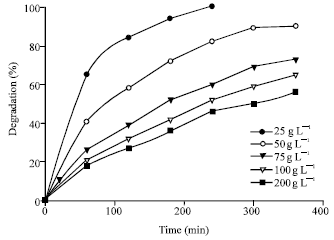 | |
| Fig. 6: | Degradation of phenol at different initial phenol concentration for quartz sand support. Conditions: T = 30°C, V = 1.4 L, pH = 7 and WTiO2 = 0.33 g L-1 |
Similar results had been reported by previous researchers (Nam et al., 2002; Chen and Ray, 1999).
Other than that, when the initial phenol concentration increases, the total phenol adsorbed on the TiO2 surface increases. Nevertheless, the radiation intensity remains the same and thus the total number of hydroxyl radical formed on the photocatalyst surface is unchanged. Therefore, with the increase of initial phenol concentration, the relative number of hydroxyl radicals to the number of phenol molecules decreases and thus result in the lower rate of reaction of phenol degradation. When the rate of reaction is low, a decrease in the apparent rate constant is observed in higher phenol concentration (Parra et al., 2002; Kamble et al., 2003).
The formation of intermediates also significantly affects the rate of reaction and the apparent rate constant. Aromatic intermediates like hydroquinone, catechol, resorcinol and p-benzoquinone are the main intermediates in the degradation of phenol (Chen and Ray, 1999; Sobczynski et al., 2004). These intermediates decrease the degradation rate by competing for the active sites on the photocatalyst surface with phenol molecules. However, the probabilities of intermediates formed depend on the initial concentration of organic pollutants. According to Chen and Ray (1999) when two experiments are conducted with initial concentration of C1 and C2 where C1>C2, the intermediates formed when C1 decreases to C2 will be adsorbed competitively to the surface of TiO2 films. This in turn, will affect the efficiency of phenol molecules adsorbed on the TiO2 surface at the same time. However, if the experiment is conducted with C2 concentration, the intermediates are not formed and the degradation rates are not affected (Chen and Ray, 1999).
In the present study, intermediates formed during the reaction are effectively destroyed at the end of reaction time. There weren’t any intermediates peaks detected in the final sample during HPLC analysis suggesting they were effectively destroyed.
CONCLUSION
The study verified the presence of TiO2 in the photocatalyst with the preferred form of anatase as the major phase. The photocatalytic degradation characteristics of phenol have also been determined in a fluidized bed reactor. The immobilized photocatalyst developed gave encouraging photocatalytic activity for decomposing organic compounds present in water and can be applied for water purification. The optimal amount of photocatalyst was found to be 0.33 g L-1 where increasing beyond this amount will result in the decrease of phenol degradation over time. It was also observed that typical application of photocatalysis was in low pollutants range where photodegradation was higher with the decrease of initial concentration of pollutants.
ACKNOWLEDGMENT
The authors acknowledge the research grant provided by University Science Malaysia and Universiti Malaysia Perlis both under short term grants that has resulted in this article.
REFERENCES
- Veeresh, G.S., P. Kumar and I. Mehrotra, 2005. Treatment of phenol and cresols in Upflow Anaerobic Sludge Blanket (UASB) process: A review. Water Res., 39: 154-170.
CrossRef - Toyoda, A., L. Zhang, T. Kanki and N. Sano, 2000. Degradation of phenol in aqueous solution by TiO2 photocatalyst coated rotating-drum reactor. J. Chem. Eng. Jpn., 33: 188-191.
Direct Link - Haque, F., E. Vaisman, C.H. Langford and A. Kantzas, 2005. Preparation and performance of Integrated Photocatalyst Adsorbent (IPCA) employed to degrade model organic compounds in synthetic wastewater. J. Photochem. Photobiol. A: Chem., 169: 21-27.
CrossRef - Pozzo, R.L., M.A. Baltanas and A.E. Cassano, 1999. Towards a precise assessment of the performance of supported photocatalysts for water detoxification processes. Catal. Today, 54: 143-157.
CrossRef - Alnaizy, R. and A. Akgerman, 2000. Advanced oxidation of phenolic compounds. Adv. Environ. Res., 4: 233-244.
CrossRef - Lim, T.H. and S.D. Kim, 2004. Trichloroethylene degradation by photocatalysis in annular flow and annulus fluidized bed photoreactors. Chemosphere, 54: 305-311.
CrossRefPubMedDirect Link - Balasubramanian, G., D.D. Dionysiou, M.T. Suidan, V. Subramanian, I. Baudin and J.M. Laine, 2003. Titania powder modified sol-gel process for photocatalytic applications. J. Mater. Sci., 38: 823-831.
CrossRefDirect Link - Balasubramanian, G., D.D. Dionysiou, M.T. Suidan, I. Baudin and J.M. Laine, 2004. Evaluating the activities of immobilized TiO2 powder films for the photocatalytic degradation of organic contaminants in water. Applied Catal. B: Environ., 47: 73-84.
CrossRef - Fujishima, A., T.N. Rao and D.A. Tryk, 2000. Titanium dioxide photocatalysis. J. Photochem. Photobiol., C, 1: 1-21.
CrossRefDirect Link - Shephard, G.S., S. Stockenstrom, D. de Villiers, W.J. Engelbrecht and G.F. Wessels, 2002. Degradation of microcystin toxins in a falling film photocatalytic reactor with immobilized titanium dioxide catalyst. Water Res., 36: 140-146.
CrossRefPubMedDirect Link - Qiu, W. and Y. Zheng, 2007. A comprehensive assessment of supported titania photocatalysts in a fluidized bed photoreactor: Photocatalytic activity and adherence stability. Applied Catal. B: Environ., 71: 151-162.
CrossRef - Nam, W., J. Kim and G. Han, 2002. Photocatalytic oxidation of methyl orange in a three-phase fluidized bed reactor. Chemosphere, 47: 1019-1024.
CrossRefPubMedDirect Link - Parra, S., J. Olivero and C. Pulgarin, 2002. Relationships between physicochemical properties and photoreactivity of four biorecalcitrant phenylurea herbicides in aqueous TiO2 suspension. Applied Catal. B: Environ., 36: 75-85.
CrossRef - Na, Y.S., D.H. Kim, C.H. Lee, S.W. Lee and Y.S. Park et al., 2004. Photocatalytic decolorization of rhodamine B by fluidized bed reactor with hollow ceramic ball photocatalyst. Korean J. Chem. Eng., 21: 430-435.
CrossRefDirect Link - Sobczynski, A., L. Duczmal and W. Zmudzinski, 2004. Phenol destruction by photocatalysis on TiO2: An attempt to solve the reaction mechanism. J. Mol. Catal. A: Chem., 213: 225-230.
CrossRef - Zhou, S. and A.K. Ray, 2003. Kinetic studies for photocatalytic degradation of eosin B on a thin film of titanium dioxide. Ind. Eng. Chem. Res., 42: 6020-6033.
CrossRefDirect Link - Kamble, S.P., S.B. Sawant and V.G. Pangarkar, 2003. Batch and continuous photocatalytic degradation of benzenesulfonic acid using concentrated solar radiation. Ind. Eng. Chem. Res., 42: 6705-6713.
CrossRefDirect Link - Pruden, A.L. and D.F. Ollis, 1983. Photoassisted heterogeneous catalysis: The degradation of trichloroethylene in water. J. Catal., 82: 404-417.
CrossRef - Chen, D. and A.K. Ray, 1999. Photocatalytic kinetics of phenol and its derivatives over UV irradiated TiO2. Applied Catal. B: Environ., 23: 143-157.
CrossRef - Khuanmar, K., W. Wirojanagud, P. Kajitvichyanukul and S. Maensiri, 2007. Photocatalysis of phenolic compounds with synthesized nanoparticles TiO2/Sn2. J. Applied Sci., 7: 1968-1972.
CrossRefDirect Link