

Henry Ongori
Department of Management, University of Botswana, Private Bag 00701, Gaborone, Botswana
Research Journal of Information Technology
Year: 2009 | Volume: 1 | Issue: 2 | Page No.: 79-85







ABSTRACT
This study tries to find out the driving forces for ICTs adoption, benefits, ICTs tools and barriers to ICTs adoption by SMEs. The methodology adopted for the study was a survey method whereby a convenience random sampling of 150 managers/owners of SMEs were selected for study in Gaborone, Botswana. The data was analyzed by descriptive statistics. The findings of the study indicated that, SMEs have not fully adopted ICTs in their business process because of internal and external challenges. This study will make pertinent contribution to the existing literature and inspire managers to come up with appropriate strategies on how to adopt ICTs in their business process in order to be competitive.
PDF Abstract XML References Citation
How to cite this article
Henry Ongori, 2009. Role of Information Communication Technologies Adoption in SMES:
Evidence from Botswana. Research Journal of Information Technology, 1: 79-85.
URL: https://scialert.net/abstract/?doi=rjit.2009.79.85
URL: https://scialert.net/abstract/?doi=rjit.2009.79.85
INTRODUCTION
Small Medium Enterprises (SMEs) are generally regarded as the cornerstone of both developed and developing economies. Most governments view SMEs as a major driver of the economy and source of employment opportunities. SMEs enterprises are often credited as agents of innovation, agents of alleviating poverty, economic growth, wealth creation and employment creation (Hanqin and Morrison, 2007; Daun et al., 2002; Mutula and Brakel, 2006). In developing countries, SMEs are the major source of income, a breeding ground for entrepreneurs and a provider of employment (Mutula and Brakel, 2007). SMEs would greatly benefit by ICTs adoption in their business processes (Maguire et al., 2007). However, as SMEs continue contributing to the economy, they are faced with many challenges which inhibit them not to compete with large enterprises. One of the major constraints is lack of ICTs adoption in their business processes. It is commonly accepted that ICTs provides many potential benefits to organizations so as to make them more efficient, effective and competitive (Fink and Disterer, 2006). However, extensive research has been done in large enterprises but in SMEs has been under researched (Cragg, 2002). Similarly, there is evidence that ICTs will increasingly empower SMEs to participate in knowledge management by facilitating connectivity, helping them to create and deliver products and services on global scale (MaCgregor, 2004). ICTs adoption by SMEs would transform the business operations by enabling rapid, reliable and efficient exchange of large amount of information. There is a plethora of definitions of SMEs which differs from one country to another. However, MacGregor and Vralalic (2007) suggested that a comprehensive definition of SMEs must include quantitative components that take into account staff level turnover and assets, together with financial and non financial measurements, but the descriptive must also include qualitative components that reflect how the business is organized and how it operates. Mutula and Brakel (2006) argued that there is no universal definition of small and medium-sized enterprises (SMEs) that is widely acknowledged. The definition varies from country to another but is often based on employment, assets, or combination of the two. In Botswana context SMEs are defined as enterprises which employs between 6 and 99 employees. ICTs refers to information and communication technologies. Therefore, ICTs are technologies and tools that people use to share, distribute, gather information and to communicate with one another, one on one, or in groups, through the use of computers and interconnected networks. In addition ICTs are mediums that utilize both telecommunications and computer technologies to transmit information.
SMEs are often seen as vital for the growth and innovation of dynamic economies as they help to diversify economies and at the same time create employment (Mutula and Brakel, 2006). Similarly, SMEs account for 60 to 70% of jobs creation in most developed and developing countries. SMEs stimulate private ownership and entrepreneurial skills. They are also flexible and can adapt quickly to changing market demand and supply situations, help diversify economic activity that significant contribution to imports and exports. In addition SMEs plays role in restructuring and streamlining of large state-owned enterprises by enabling them to abandon and/or sell off non-core production activities and by absorbing redundant employees. SMEs increase the competitiveness of the market and curb the monopolistic positions of large enterprises. Similarly SMEs act as seed-bed for the development of entrepreneurial skills, innovation and they play an important part in the provision of services to the community (Lasch et al., 2007). The impact of globalization has compelled SMEs to adopt ICTs, to enable SMEs to survive and compete with large companies. The business environment is not static and geographical distances are of no importance for customer-supplier relationships (Sharma and Bhagwat, 2006). Evidence shows that durable productivity gains have been achieved in enterprises which have adopted information and communication technology (Dangayach and Deshmukh, 2003; Sheils et al., 2003). The rate of expansion of globalization has encouraged among other things the effective flow of data in organizations, which can only be facilitated by the use of ICTs. The study conducted by Sharma and Bhagwat (2006) argued that the flow of information in an organisation is the blood life of any business operating unit irrespective of its size.
In this era of globalization the revolution of ICTs has affected the way businesses operate. First, it has changed the business structures and altered the degree of competition. Secondly, it has created a competitive advantage for the businesses which have adopted ICTs. Thirdly, it has affected the new businesses operations. These changes have compelled SMEs to adopt ICTs in order to cope with these changes in the environment (Casolaro and Gobbi, 2007).
ICTs adoption by SMEs provides means to access, process and distribute greater amounts of information to the concerned personnel within an organization. This aids management to make quick and thoughtful decisions to assist SMEs in strategic planning (Jimmy and Li, 2003).
There is need to embrace the state-of-art technologies especially in SMEs in order to penetrate international markets and remain competitive despite the challenges posed by globalization, liberalization and technological changes. In addition SMEs are faced with competition from multinational corporations in the domestic market (Sharma and Bhagwat, 2006). These competitions are in form of reduced costs, improved quality products with high performance, wide range of products and better services, all delivered simultaneously to enhance the value of their customer (Dangayach and Deshmukh, 2003). This situation has forced SMEs to adopt ICTs in order to counter the competition posed by large and multinational companies.
Windrum and De Berranger (2002) argued that the contributing factors for ICTs adoption by SMEs can be categorized into five major clusters that include: the business characteristics; business action; system characteristic; internal and external expertise. Business characteristics include size, determines the business structure that in turn strongly influence business ICTs uptake. SMEs have simple structures when compared to large businesses and have less internal requirement for extensive communication technologies. Business action is driven from the top management. Business owner/ manager establish appropriate ICTs goals; identifies critical ICTs needs and allocates financial resources for the same. This makes ICTs adoption by SMEs possible. System characteristics within a business aids in ICTs adoption. For instance SMEs with large number of administrative applications readily support ICTs adoption as a tool for management control, operational control and administration.
Harker and Akkeren (2002) stated that factors which influences ICT adoption in SMEs includes: organisation`s ICT readiness; external pressure to adopt, customer/supplier dependency, structural sophistication of the businesses, size, sector and status and its information intensity.
ICTs adoption by SMEs increases productivity in the production process; enhances and increases efficiency of internal business operations; and connecting SMEs more easily and cheaply to external contacts (Pokharel, 2005; Taylor and Murphy, 2004). Similarly ICTs adoption by SMEs improves the operational efficiency, reduce operations cost and create global market access to SMEs (Schware, 2003).
ICTs adoptions by SMEs are faced with many challenges especially poor ICTs infrastructure, lack of ICTs technical and managerial capacity. In addition, lack of awareness and understanding of ICTs are also considered as obstacles among SMEs in adopting ICTs to enhance their business processes. In addition lack of human resources, comprehensive legal framework, language barriers and lack of confidence and trust in new technologies by SMEs are the main barriers of ICTs adoption. Taylor and Murphy (2004) consented that some SMEs occupy small and clearly defined niche markets, sometimes entirely local and they do not need the global connectivity available through the Internet. These niches of market can be penetrated by the word-of-mouth since it guarantees quality, service and reliability and these are businesses where trust and stability underpin successful operations. SMEs are at the very least perceptions of unresolved security and privacy issues associated with the use of the Internet and therefore, SMEs are not ready to adopt ICTs in their business processes. Stockdale and Standing (2002) argued that the barriers to ICTs adoption by SMEs includes lack of resources and knowledge, the skills levels of business operators, lack of trust in the ICTs and lack of recognition of the potential to improve business appropriate to the effort and costs of adoption and lack of understanding of the realizable benefits. In addition Kari (2007) stated that in many developing world still they lack the most basic forms of information and communication infrastructure.
The objectives of the study were to find out the driving forces for ICTs adoption, benefits and barriers to ICTs adoption by SMEs.
MATERIALS AND METHODS
To achieve the objectives of the study, cross sectional survey design was selected for the study. The survey was selected to get perceptions of managers/owners of SMEs in ICTs adoption in their business processes. The research was conducted from September 2007-April 2008.
Survey Instrument
The research instrument used for collecting data in the study was a questionnaire. The questionnaire is most popular instrument in collecting data (Daun et al., 2002; MaCgregor, 2004; Pokharel, 2005; Ramsden and Bennet, 2005; Vos et al., 2007; Vehovar and Lesjak, 2007). The questionnaire was developed for SMEs managers/owners. The research instrument was divided into two parts. Part, A, dealt with the demographic data of the respondents and part B, comprised of the driving forces for ICTs adoption, ICTs tools, benefits and barriers to ICTs adoption by SMEs. The respondents` were asked to rate the driving forces, benefits, ICTs tools and barriers to ICTs adoption across the 5 point Likert scale where 1 indicates strongly disagree and 5 indicates strongly agree. To ensure that the research instrument met the required standards, a pilot study was conducted with five managers/owners of SMEs, three academicians and two ICTs experts. Their comments and suggestions were incorporated before the final distribution of questionnaires.
Sampling Plan
The research focused on managers/owners of SMEs in Gaborone, Botswana. The convenience random sampling of 150 managers/owners and employees of SMEs were selected for the study. This was applied to get perceptions of managers/owners about ICTs adoption by SMEs. Thus the numbers of managers/owners and employees targeted for study was (n = 150) but duly completed and returned questionnaires was (n = 120) which accounted to 80% of the respondents.
RESULTS AND DISCUSSION
Demographics of the Respondent
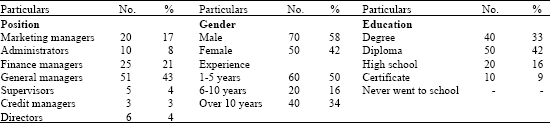
Table 1 shows the distribution summary of the respondents. It indicates that most the respondents surveyed were general managers who accounted (43%) and finance manager`s (21%). On gender distribution, males accounted (58%) and females (42%), respectively. This reflects that most of SMEs are operated and managed by males. Managers` who are managing SMEs have experience of less than 10 years accounted (50%) and over ten years (34%), respectively. Most of these managers have diploma qualifications and above accounted to 76%.
Profile of Sample Firms
The survey highlights that most data was collected from manufacturing SMEs (77.3) and business service (22.7%). Most SMEs are owned by corporations (63%), partnership (23%) and sole proprietorship (14%). This clearly indicates that partnership and corporations accounts to (86%) of ownership of SMEs surveyed. The age or the existence of SMEs surveyed indicates that most of the SMEs have been in operational for over 6 years which accounted to (64%) and less than less than 6 years (36%).
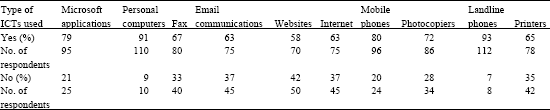
The respondents were asked to tick the ICTs tools used in their businesses. Table 2 shows the results of ICTs tools used by SMEs are landline phones (93%), personal computers (91%), cell phones (80%) and micro soft applications (79%). In addition other ICTs tools used by SMEs include fax, photocopiers, internet access, e-mail communication and printers. Thus these findings are consistent with previous researchers (Mutula and Brakel, 2006).
| Table 1: | Demographics of the respondents |
 | |
| Table 2: | ICT Tools used in SMEs (N = 120) |
 | |
| Table 3: | Perceived driving forces, benefits and barriers to ICTs by SMEs |
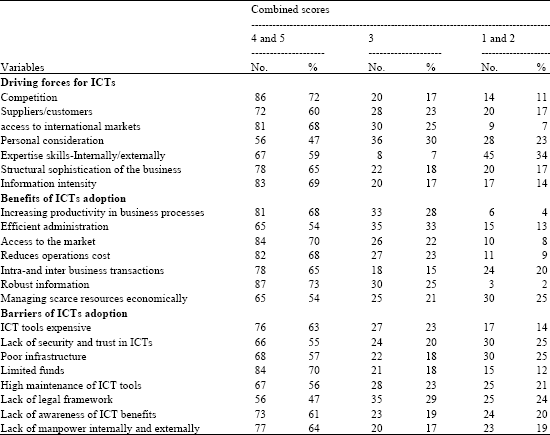 | |
Table 3 highlights the driving forces, benefits and barriers to ICTs adoption by SMEs. The respondents were asked to rate the driving forces for ICTs adoption in their business processes. The results indicated that ICTs are adopted by SMEs because of competition (72%), information intensity (69%), access into international markets (68%), structural sophistication of the business (65%) and suppliers/customer`s needs quick service delivery (60%). Similarly ICTs adoptions by SMEs are driven by the availability of human resource skills both internally and externally (59%). This motivates managers/owners to adopt ICTs in their business processes without any major problem. Thus the availability of human skills both internally and externally accelerates the degree of ICTs adoption by SMEs. Thus, Sheils et al. (2003) argued that the major driving forces for ICTs adoption by SMEs are competition, suppliers/customers and the nature of the business.
SMEs greatly stands to benefit in ICTs adoption in their business process especially in accessing to robust information which would enable managers/owners to make thoughtful decisions especially in strategic planning of SMEs (73%) and access to international markets (70%). In accessing global markets, SMEs will be in a position to sell their products and this would have positive long-run effects on operational profits. In addition SMEs will benefit in reducing the operational costs and increasing productivity of the businesses (68%). Similarly, SMEs would benefit by intra and inter business transactions (65%). These findings are consistent with previous researchers (MacGregor, 2004; Sheils et al., 2003).
On ICTs adoption by SMEs, the results indicated that the major barriers to ICTs adoption by SMEs are limited funds (70%), lack of internal and external skills (64%) and ICTs tools are expensive (63%). In addition other barriers are most managers are not aware of the potential benefits of ICTs, poor infrastructure (57%) and lack of legal framework (47%).
CONCLUSION AND IMPLICATIONS
SMEs are compelled to adopt ICTs because of competition. They are forced to provide quality products at a cheaper rate, therefore the need to make thoughtful decisions to satisfy their customer needs. In addition, SMEs have been forced to adopt ICTs in their business process in order to have access to international markets. SMEs stand to benefit in ICTs adoption especially in accessing robust information, access to international markets and Intra and inter-businesses transactions. All these will enable SMEs to compete with large business. However, SMEs are faced with many barriers in ICTs adoption. These barriers include frequent power failure, ICTs tools are expensive, lack of awareness of managers/owners about the benefits of ICTs and lack of skilled labour internally and externally.
The findings from this study will make pertinent contribution to the body of knowledge. It is also hoped that, the findings will be useful for business owners/managers of SMEs and other interested parties in both developed and developing economies on ICTs adoption. Thus ICTs plays a great role in SMEs. SMEs deserve special attention in order to diversify the economic activities of an economy, more especially on ICTs adoption framework. This would enable SMEs to remain competitive.
This study considered the sample size of SMEs in Gaborone city and its surroundings. Therefore, the results and conclusions cannot be generalized to SMEs which were not part of the study. Hence, there is need for nationwide outlook study to incorporate larger sample size of SMEs by using a longitudinal approach to get an insight of ICTs adoption by SMEs.
REFERENCES
- Casolaro, L. and G. Gobbi, 2007. Information technology and productivity changes in the banking industry. Econ. Notes, 36: 43-76.
CrossRef - Cragg, P.B., 2002. Benchmarking information technology practices in small firms. Eur. J. Inform. Syst., 11: 267-282.
CrossRefDirect Link - Duan, Y., R. Mullins, D. Hamblin, S. Stanek and H. Sroka et al., 2002. Addressing ICTs skill challenges in SMEs: Insights from three country investigations. J. Eur. Ind. Traizning, 26: 430-441.
CrossRef - Dangayach, G.S. and S.G. Deshmukh, 2003. Evidence of manufacturing strategies in Indian industry. Int. J. Prod. Econ., 83: 279-298.
CrossRef - Fink, D. and G. Disterer, 2006. International case studies: To what extent is ICT infused into the operations of SMEs. J. Enterprise Inform., 19: 608-624.
CrossRef - Hanqin, Q.Z. and A. Morrison, 2007. How the small to medium sized travel agents stay competitive in China’s travel service sector. Int. J. Contemporary Hospitabil. Manage., 19: 275-285.
CrossRef - Jimmy, J.M. and K.X. Li, 2003. Implications of ICT for knowledge management in globalization. J. Inform. Manage. Comput. Security, 11: 167-174.
CrossRef - Kari, H.K., 2007. Availability and accessibility of ICT in the rural communities of Nigeria. Elect. Library, 25: 363-372.
CrossRef - Lasch, F., F.L. Roy and S. Yami, 2007. Critical growth start-ups. Manage. Decision, 45: 62-75.
CrossRef - MacGregor, R.C., 2004. Factors associated with formal networking in regional small business: Small findings from Swedish SMEs. J. Small Business Enterprise Development, 11: 60-70.
CrossRef - Maguire, S., S.C.L. Koh and A. Magrys, 2007. The adoption of e-business and knowledge management in SMEs. Int. J., 14: 37-58.
CrossRef - Mutula, M.S. and P.V. Brakel, 2006. E-Readiness of SMEs in the ICT sector in Botswana, with respect to information access. Elect. Library, 24: 402-417.
CrossRefDirect Link - Mutula, M.S. and P.V. Brakel, 2007. ICT skills readiness for the emerging global digital economy among the SMEs in developing economies: Case study of Botswana. Libray Hi Tech, 25: 231-245.
CrossRef - Pokharel, S., 2005. Perception on information and communication technology perspectives in logistics. J. Eur. Inform. Manage., 18: 136-149.
CrossRef - Ramsden, M. and R.J. Bennett, 2005. The benefits of external support to SMEs. J. Small Bus. Enterprise Dev., 125: 237-243.
CrossRef - Sharma, M.K. and R. Bhagwat, 2006. Practice of information systems: Evidence from select Indian SMEs. J. Manuf. Technol., 17: 199-223.
CrossRefDirect Link - Sheils, H., R. Mclover and D. O’Reilly, 2003. Understanding the implications of ICT adoption: Insights from SMEs. Logistics Inform. Manage., 16: 312-326.
CrossRef - Schware, R., 2003. Information and communications technology (ICT) agencies: Functions, structures and best operational practices. J. Inform. Syst., 5: 3-7.
CrossRef - Stockdale, R. and C. Standing, 2002. Benefits and barriers of electronic market place participation: An SME perspective. J. Enterprise Inform. Manage., 17: 301-311.
CrossRef - Taylor, M. and A. Murphy, 2004. SMEs and e-business. J. Small Business Enterprise Dev., 11: 280-289.
CrossRef - Harker, D. and J.V. Akkeren, 2002. Exploring the needs of SMEs for mobile data technologies: The role of qualitative research. J. Res. Practice Inform. Tech., 5: 199-209.
CrossRef - Vehovar, V. and D. Lesjak, 2007. Characteristics and impacts of ICT investments: Perceptions among managers. Ind. Manage. Data Syst., 107: 537-550.
CrossRef - Vos, E., A.Y.J. Yeh, S. Carter and S. Tagg, 2007. The happy story of SMEs financing. J. Banking Finance, 31: 2648-2672.
CrossRef - Windrum, P. and P.D. Berranger, 2002. Factors Affecting the Adoption of Intranets and Extranets by Smes a UK Study. 1st Edn., Manchester Metropolitan University, Manchester, ISBN: 1478-8209.
Direct Link
Kimboka Stambul Reply
The paper is short but so professionally set as all the key issues are contained therein