

R.O. Babatunde
Department of Agricultural Economics and Social Sciences (490b), University of Hohenheim, D-70593 Stuttgart, Germany
Trends in Agricultural Economics
Year: 2008 | Volume: 1 | Issue: 1 | Page No.: 35-41







ABSTRACT
This study uses household`s survey data to analyze income portfolios and determinants in rural Nigeria. The results indicate that, while farming accounts for half of total household`s income, the other half is from different off-farm sources. Considering income composition across poverty groups, the results show that farm and remittance income are the main income sources for the poor households and therefore any policies that can address these income sources will have the greatest impact on poverty reduction. On the other hand, off-farm employment especially self-employed activities are the main income sources of the relatively better-off households. Econometric analysis shows that household assets, size, farm size, social infrastructure and market access are important determinants of total income. Policies that would simultaneously promote the development of the agricultural and off-farm sectors are suggested to reduce poverty in rural Nigeria.
PDF Abstract XML References Citation
How to cite this article
R.O. Babatunde, 2008. Income Portfolios in Rural Nigeria: Composition and Determinants. Trends in Agricultural Economics, 1: 35-41.
DOI: 10.3923/tae.2008.35.41
URL: https://scialert.net/abstract/?doi=tae.2008.35.41
DOI: 10.3923/tae.2008.35.41
URL: https://scialert.net/abstract/?doi=tae.2008.35.41
INTRODUCTION
There is a general agreement that poverty is widespread and prevalent in developing countries. Many studies have also confirmed that the rate of poverty in the rural areas is higher than in urban areas (De Janvry and Sadoulet, 2001; Deininger and Olinto, 2001; Escobal, 2001). What is still a subject of debate however is the best strategy for reducing rural poverty (Lanjouw, 2001). Several poverty reduction strategies have been suggested and used in different contexts. In Africa, the focus of poverty reduction strategies has been on agricultural growth as the pathway out of extreme poverty. However, unlike in many Asians and Latin American countries, where agriculture-led growth played an important role in reducing poverty and transforming the economies, the same has not yet occurred in Africa. Most countries in Africa have not yet met the criteria for a successful agricultural revolution and factor productivity lags far behind the rest of the world. This has led to growing skepticism in the international development discourse about the relevance of agriculture to growth and poverty reduction in the region. At least, the Green Revolution, that worked well elsewhere, was less successful for rural development in Africa, which was partly due to differences in farming systems, climate and infrastructure (Ellis, 2000).
The failure of many poverty reduction interventions has been because they ignored the great diversity and heterogeneity in assets portfolios across rural households and the range of activities in which they engage to generate income (De Janvry and Sadoulet, 2001). But, now it has been discovered that peasant households in developing countries typically earn income from many different sources (Dercon and Krishnan, 1996; Block and Webb, 2001). Literatures on income diversification across developing countries have pointed to the increasing role of off-farm income in poverty reduction (FAO, 1998; Matshe and Young, 2004) and with increasingly limited agricultural resources; many have proposed a poverty reduction strategy, which would focus on the role of the off-farm sector to eradicate poverty and ensure equitable rural development.
The goal of any poverty reduction strategy is to increase income and other welfare indicators. Any policy which aim is to increase income must first understand the composition and determinants of rural income, so that target interventions can be applied appropriately. This research examines the income portfolios of farm households in rural Nigeria. It specifically provides an in-depth understanding of the diverse activities in which they engage to generate income, the income from each activity and the factors that affect total income. The study examines whether the poor differ from the rich households in their income generating activities and which income activity is more important to the poor households. It is envisage that the results of the study will contribute meaningfully to the design of effective poverty reduction strategies that would benefit the poor households.
MATERIALS AND METHODS
Data used in this research are from a comprehensive household income and expenditure survey of farm households in Kwara State, North-Central region of Nigeria. The data were collected between April and August 2006. Kwara State was chosen as the survey area because of its considerable socioeconomic heterogeneity and location; it is the gateway between the northern and southern regions and it has a good mixture of the three major ethnic groups in Nigeria. These factors tend to encourage the development of off-farm activities in the area. Apart from this, Kwara State also has a characteristic of high prevalence of poverty. The nationwide Living Standard Measurement Survey (LSMS) conducted in 2004 shows that the state is among the six poorest in Nigeria in terms of income poverty (National Bureau of Statistics, 2006). Thus, the contrasting features of a thriving off-farm sector bedevil with a high poverty rate makes the State an interesting study area.
The total estimated population of the State is about 2.4 million people out of which 70% can be classified as smallholder farmers. The State has a total land area of about 32,500 km2, which is about 3.5% of the total land area of the country, which is put at 923,768 km2 (KWSG, 2006). Approximately 25% of the land area of Kwara State is use for farming. A humid tropical climate prevails over the state and it has two distinct seasons; the wet and dry seasons. The farming system is characterized by low quality but surplus land, low population density and predominantly cereal-based cropping pattern. Farm enterprises are generally small in size, so that-and in spite of own production-most households are net buyers of food, at least seasonally (KWSG, 2006).
The sample consists of 220 farm households, which were chosen by a multi-stage random sampling technique. Eight out of the 16 local government areas (the lowest administrative unit in Nigeria) in the state were randomly selected in the first stage. Then, five villages were randomly selected from each of the 8 local government areas and finally, five to six households were sampled in each of the 40 villages, using complete village household lists provided by the local authorities. Apart from migrant farm workers, who come from other states on a seasonal basis, all households living in the villages can be classified as farm households, suggesting that they cultivate at least a small piece of land. There are no landless rural households in the study area. The survey questionnaire was designed to gather information on household composition and other socioeconomic data, including details on the participation of individual household members in different income-generating activities. Broadly, I disaggregate activities and income into seven categories: (i) crop income, (ii) livestock income, (iii) agricultural wage income, representing earnings from supplying agricultural wage labor to other farms, (iv) non-agricultural wage income, including from both formal and informal employment, (v) self-employed income from own businesses, (vi) remittance income received from relatives and friends not presently living with the household and (vii) other income, mostly comprising capital earnings and pensions.
RESULTS AND DISCUSSION
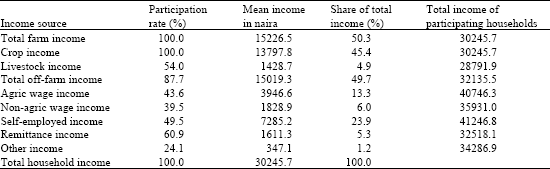
The result of Table 1 show that, the average income of rural households and the sources from which the income is derived. The Table 1 also shows how different income sources contribute to total household income in the sample. In order to better reflect household`s living standards, the analyses build on per adult equivalent income instead of total income. The results indicate that all households derive income from farming, which, however, only accounts for half of total income on average. The other half is derived from different off-farm sources. Crop farming, which is mainly subsistence in nature, is by far the most important single source of income for the rural households, providing about 45% of total income. This finding is consistent with those of other studies from similar settings (Dercon and Krishnan, 1996; Van den Berg and Kumbi, 2001; Karugia et al., 2006; Abdulai and Delgado, 1999). Despite the growing scepticism on the role of agriculture for reducing poverty among rural household, this result shows that, it remains the major source of rural income.
More than half of the sample households derive income from livestock enterprises, but income from this source is only 5% of total income. This suggests that the type of livestock activities is small-scale, mostly extensive free range backyard type. Eighty-eight percent of the sample households in rural Nigeria receive income from off-farm sources and self-employed income is the most important, accounting for 24% of total income and 48.5% of off-farm income. Self-employed income is mainly derived from handicrafts, food processing, shop-keeping and other local services, as well as trade in agricultural and non-agricultural goods. Forty percent of the households participate in non-agricultural wage activities, but this source only contributes 6% to total income. The non-agricultural wage employment includes formal and informal jobs in construction, manufacturing, education, health, commerce, administration and other services. The smaller contribution of non-agricultural wage income to total income could be because of the little educational and professional qualification of the rural farmers, which reduce their earning from available non-agricultural activities.
Even though all the sample households have land, about 44% receive income from supplying agricultural wage labour, which accounts for about 13% of total income. The phenomenon by which landed farmers, as oppose to landless farmers, participate in supplying wage labour is common in the study area. The reasons for this include the need to earn cash income to meet urgent financial need, reduce income risks and finance farm expansion (Reardon, 1997; Lanjouw and Lanjouw, 2001). Nearly two-thirds of the households receive remittances from local and international sources, but it contributes only 5% to total income. Given that a larger proportion of the households receive remittance income, which contribute a smaller share of total income, it would be risky for poor households to rely on this income source. Moreover, it depends more on the economic situation of the givers. The least important income source is other income, comprising capital earnings and pensions, contributing only 1% to total income.
| Table 1: | Average composition of household incomes (N = 220) |
 | |
Official exchange rate in 2006: 1 US dollar = 120 naira. Income estimates are based on annual per capita incomes expressed in terms of adult equivalents | |
Considering the total income of households participating in the various income activities, the results show that households participating in self-employed activities receive the largest annual income per adult equivalent of about 41,247 naira or US $ 344. This indicates that self-employed activity is the most remunerative and the productivity of family labour is highest in self-employed activities in the area. However, because establishing self-employed business require initial investment, households that are disadvantage in terms of financial capital, will be constraint from reaping the potential benefit of self-employed activities. Table 2 shows the contribution of household members to total off-farm income among the sample households. While the household head accounts for the largest share on average, it becomes evident that there are also significant contributions by other household members, including the spouse, older children and other relatives. The contribution of spouses is more through remittances, while other members contribute more through non-agricultural wage employment. Both men and women are engaged in all activity categories, indicating that there are no strict cultural restrictions, although certain gender patterns emerge when further disaggregating by sectors.
Income Portfolio According to Household Types
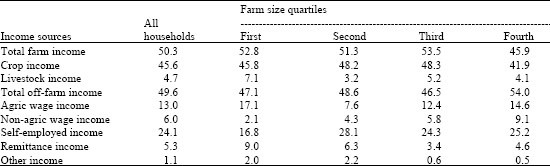
Here, income portfolios in a more disaggregated way is described. Households classification is first by farm size and then by income quartiles. Table 3 shows percentage income composition by farm size quartiles. It is worth noting, however, that farm size was not adjusted for quality. Notably, share of off-farm income increase with increase in farm size. This shows that farm and off-farm activities are complementary rather than substitutes. In the study area, land in general is not a major constraint for increasing agricultural production because permission to use land is usually granted by the village head and farmers may cultivate as much land as their capacity permits. Rather, financial capital for buying farm inputs, machinery, or to pay for hired labor seems to be the scarcest factor. Given this condition coupled with the failure of rural credit markets, cash income from off-farm sources can help to pay for agricultural inputs and expand the farm size accordingly. This is why households with larger share of off-farm income also cultivate larger farm size. This result dispute the concern that working off-farm can reduce agricultural production as a result of competition for family labour between farm and off-farm works.
The result further shows that share of farm income decreases with farm size. Among the off-farm income sources, the smallest farms derive higher share from agricultural wage labor, remittances and other income. This suggests that these income sources are more important to the small farmers than larger farmers, for whom non-agricultural wage and self-employment are more important.
| Table 2: | Percentage contributions of household members to annual off-farm income |
 | |
| Table 3: | Percentage composition of annual per capita income by farm size |
 | |
| Table 4: | Percentage composition of annual per capita income by income quartiles |
 | |
| Table 5: | Descriptive statistics (N = 220) |
 | |
| Official exchange rate in 2006: 1 US dollar = 120 naira; SD is standard deviation. AE is adult equivalent | |
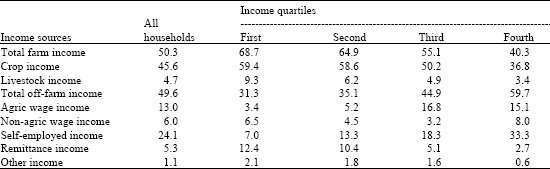
Table 4 shows that for the poorest households, farming (crop and livestock) is the most important income source, accounting for over two-thirds of total income. The share of off-farm income increases with total income, indicating that the richest households derive the largest income share from off-farm activities. Self-employed activities are exceptionally important for the richest households. This is not surprising, because establishing an own business often requires seed capital. The result is also in line with the earlier one that identifies self-employed activities as the most lucrative for investing family labor. Remittance and other income are more important for the poorest households. This suggests that, targeting the poor with transfer income, could offer some pathway out of poverty. However, this must be done with caution because of the concerns that have been raised about the effectiveness of such income targeting in developing countries.
Determinants of Total Income
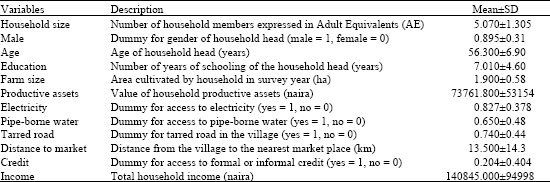
Here, the study analyze the determinants of total income at the household level. This is useful in particular, to understand the factors which affect total income and why the income of some households is large and others are small. I estimate a regression model of total income against a set of explanatory variables, using the Ordinary Least Square (OLS) techniques. The sample statistics of the dependent and explanatory variables included in the model are shown in Table 5.
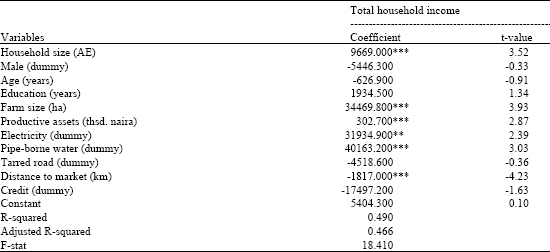
Of the eleven variables included in the regression model, six were found to have significant impact in determining household total income (Table 6). Household size has a positive impact on total income. This is not surprising, as income is not expressed in per capita term. Every additional adult equivalent added to the household increases total income by approximately 10,000 naira on average. Farm size positively influences total income and increasing the land size by one hectare would increase income by about 34,500 naira. The results also indicate that increasing household assets by 1000 naira would increase total income by 300 naira on average. This result is quite consistent with those of other similar studies (Karugia et al., 2006; De Janvry and Sadoulet, 2001).
| Table 6: | Determinants of total household income (OLS, estimates) |
 | |
| *, **, ***Coefficients are significant at the 10, 5 and 1% level, respectively; The dependent variable is the total annual household income expressed in naira. N = 220 | |
Expectedly, access to electricity and pipe-borne water influence total income in a positive and significant way. These social capital are particularly important because they facilitate the starting-up of an own business and contribute to higher average incomes from those businesses. Moreover, the presence of these social capital in the villages could increase economic opportunities and improve the income earn from both farm and off-farm activities. Inability to access the market reduces household income. Households that are located one kilometer farther away from urban market center would have their income reduced by about 1800 naira. Overall, the results suggest that household assets and social capital are the significant factors that affect total income. Education and gender have no influence on total income in the study area. Provision of social infrastructure as well as empowering the rural households to enhance their assets position is likely to raise income and reduce poverty in the area.
CONCLUSION
This study examined income portfolios and determinants of total income among rural farm households in Kwara State, Nigeria. The results show that households earn income from many different sources and that 50% of total income is from farming while the other 50% is from different off-farm sources. While crop farming is the dominant source of farm income, accounting for about 45% of total household`s income, self-employed activities are the dominant sources of off-farm income, accounting for nearly one-quarter of total income. The share of off-farm income increases with increase in farm size, indicating that there are important complementarities between farm and off-farm activities in the area. With regard to the question raised in the introduction, of whether the poor differ from the rich households in their income activities and which income source is more important to different type of households, the result clearly show that for the poor households, farming is the main income source. On the other hand, for the relatively rich households, off-farm employment and especially self-employed activities are the main income sources. Econometric analysis shows that household assets, size, farm size, social infrastructure and market access are the significant factors that determine total income.
The first policy implication of the results is that agricultural activities should be promoted, because it remains the major income source of the rural poor. Despite the growing concern, the findings of this paper demonstrate that there is scope for poverty reduction through agricultural growth. Efforts such as distribution of improved seed varieties and better extension services delivery can help to boost agricultural production. The second implication is that direct targeting of the poor households for income transfer should also be considered in designing poverty reduction strategies. The result shows that apart from farming, the poor households also rely more on remittance income and targeting them could offer some pathway out of poverty. Finally, the results of this study indicate that farm and off-farm activities are complementary rather than substitute and this dispute the skepticism that working off-farm can reduce agricultural production due to competition for family labor between farm and off-farm work. Therefore, there is need for policy instruments that would ensure the simultaneous development of both sectors. For instance, accessible credit schemes and provision of physical infrastructure like electricity, pipe-borne water and market, would increase overall employment opportunities and development in the two sectors.
REFERENCES
- Abdulai, A. and C.L. Delgado, 1999. Determinants of nonfarm earnings of farm-based husbands and wives in Northern Ghana. Am. J. Agric. Econ., 81: 117-130.
CrossRefDirect Link - Block, S. and P. Webb, 2001. The dynamics of livelihood diversification in post-famine Ethiopia. Food Policy, 26: 333-350.
Direct Link - Deininger, K. and P. Olinto, 2001. Rural nonfarm employment and income diversification in Colombia. World Dev., 29: 455-465.
Direct Link - De-Janvry, A. and E. Sadoulet, 2001. Income strategies among rural households in Mexico: The role of off-farm activities. World Dev., 29: 467-480.
Direct Link - Dercon, S. and P. Krishnan, 1996. Income portfolios in rural Ethiopia and Tanzania: Choices and constraints. J. Dev. Stud., 32: 850-875.
CrossRefDirect Link - Ellis, F., 2000. The determinants of rural livelihood diversification in developing countries. J. Agric. Econ., 51: 289-302.
Direct Link - Escobal, J., 2001. The determinants of non-farm income diversification in Peru. World Dev., 29: 497-508.
Direct Link - Karugia, J.T., W. Oluoch-Kosura, R. Nyikal, M. Odumbe and P.P. Marenya, 2006. Access to land, income diversification and poverty reduction in rural Kenya. Proceedings of the International Association of Agricultural Economists Conference, August 12-18, 2006, Australia, pp: 1-18.
Direct Link - Lanjouw, J.O. and P. Lanjouw, 2001. The rural non-farm sector: Issues and evidence from developing countries. Agric. Econ., 26: 1-23.
Direct Link - Lanjouw, P., 2001. Nonfarm employment and poverty in rural El Salvador. World Dev., 29: 529-547.
Direct Link - Matshe, I. and T. Young, 2004. Off-farm labour allocation decisions in small-scale rural households in Zimbabwe. Agric. Econ., 30: 175-186.
Direct Link - Reardon, T., 1997. Using evidence of household income diversification to inform study of the rural nonfarm labor market in Africa. World Dev., 25: 735-748.
CrossRefDirect Link - Van-den-Berg, M. and G.E. Kumbi, 2006. Poverty and the rural nonfarm economy in Oromia, Ethiopia. Agric. Econ., 35: 469-475.
Direct Link
AKHARUME DEBORAH Reply
EXCELLENT